Tuesday, 27 September 2011

Music on Silk Crepe.


Today the rice paste was used to resist the stencil pattern as usual but instead of indigo, I boiled down different dye baths from high tannic barks and red madder and used them with an iron mordant to get this effect. It was steamed to set the color.

Something about this reminds me of Pablo Casals playing Bach. The fabric is a perfect silk crepe. This stuff if usually too refined and snooty. How to build on the chilliness without nodding off is the question. It may not be a moody, bloody, passionate Cello Suite but it made us smile in a similar way.

Monday, 26 September 2011

Banana Stock Threads to Fabric: National Treasure


The Okinawan islands are at the very southern tip of the Japanese archipelago. The islands are closer to Taiwan than the actual Japanese main islands. The climate is tropical and the customs and language quite different from the rest of Japan. The islands remained under American jurisdiction after world war two until 1972. The Okinawans have had it tough and still suffer living with huge American Military bases in their midst. Due to the strategic position of the islands it is doubtful that the military bases will be moved.

Kimono from this area has traditionally been made from the stalk of Banana plants. The woven textiles seem to have soaked in the sunshine and the hardship as well as the refinement and strength of the land and the Okinawans.

Taira Toshiko san grew up under the occupation and economically suffered most of her life. I've never met her but I have lifted a few inspirational patterns from her repertoire to use in my own weaving.

The process of making the threads is much like the traditional methods for making thread and weaving other plant fibers. The finished woven rolls of fabric are floated in the salt water to set the weave and color unlike their northern brethren which are laid to set on the cold frozen snow of the snowy regions of Japan. More or less Japan sits on a North-South Axis. The clothing tradition was enriched by the topographical and climate variations.

I would love to take a year off my busy life in the middle of Japan and head south to a slower paced life and study the Okinawan textiles. What a dream...

Wednesday, 14 September 2011

Living National Treasure: part two.

Sorry for another semi used posting.

Ayano Chiba standing in her indigo field in winter.


Late 20s living in Japan, working as a English re-writer. Sitting by a fax machine in computer chip manufacturer while people handed me faxes in semi-broken English. I would patch up the English and fax away to the head office in the States. On the weekends I was studying Japanese ink painting and was getting orders to do paintings for interiors of Japanese restaurants. Every few months I would fly down to Java in Indonesia for a few weeks by myself and roam around. It was here I took a deeper look at the handwoven textiles from all the different islands of the archipelago. In villages I saw some women dying with indigo and natural dyes but it did not register exactly what they were doing or the significance of it. I took some batik courses and purchased ikats from over priced boutiques in Bali.

I was in a bookstore in Tokyo's Shinjuku one afternoon. I was looking for something. My bookshelves were overflowing with books and magazines on ink painting and pottery. I picked out the Shibori book by Yoshiko Wada, Mary Kellog Rice, and Jane Barton. I read a one page description of how Ayano Chiba the National Treasure planted her own indigo and processed it and dyed with it. I shut the book, snuffle chuckled and took it the cash register. 'OK. Now that the rest of my life is decided I can go have a beer.'

I was going to grow my own indigo and be an indigo craftsman. It seemed exactly right.

And I did. I got indigo seeds, grew, harvested and fermented exactly as was written in the book and dyed away.
Beginners luck I suppose. I have tried several ways to ferment the indigo leaves and the vat itself but I still do it the same way that Ayano Chiba did.


Her background set the criteria for what I figured a Living National Treasure should be. An anonymous person living in a backwater somewhere who had some skill that they had absorbed after a lifetime of working on it. She was doing it for the love of the process.

She was born in 1889 and passed away in 1980. She also grew hemp and processed it into threads by hand and wove it into kimono and then dyed the material. Her daughter carried on her work after her death.

I can see now that some Living National Treasures aim for the title and invest time and money in getting the status. They mostly deserve the recognition and it helps bring awareness to the value of culture to a country that often has it's priorities focused on surviving in this material society. There is a purity in Chiba san's compelling story though. Someone found her. She didn't go looking.

Tuesday, 13 September 2011

Paper and Cotton Knit Arashi Shibori


The material is a tube knit of 30% paper and 70% cotton. We stitched it and pulled it and then pole wrapped it then pushed and twisted and dyed it with one dip in the indigo.

This will be made into a long-sleeved t-shirt.

The One Year Obi Project


Kawamoto san and Kamei san started to make these obis (kimono belts) over a year ago.
First they decided the pattern and cut stencils. Then made the resist paste by steaming rice flour and bran. The pattern was dyed seven times in indigo to get the darker blue. (It is quite a feat to dye something that long and sticky with glue without making a mess!) The obi was then washed and dried and re-pasted with the stencil slightly shifted to give a lighter blue three dip shadow. The obi was washed again and slightly offset resist pasted again. By this time it was autumn last year and there were not enough ultra-violet rays (that are required to change the color) left in the sun so we had to wait for summer this year. It was dyed ten times with persimmon tannin and after each dye it was dried in the hot sun to get the golden brown .

Finally today we removed the paste and the results were worth the time and effort. It was a good study as well.Their faces lit up while discussing next years persimmon tannin indigo obi and the potentials to build on these techniques and aesthetics.

Thursday, 8 September 2011

National Treasure.

I posted this on the tour blog yesterday. I've been busy with house construction again. Sorry to those of you getting a semi-used post!

The Japanese government, with the goal of preserving important intangible cultural assets supports a system of 'Living National Treasures'. There are 16 categories in the performing arts and crafts: Gagaku, Noh, Bunraku, Kabuki, Kumi Odori, Music, Dance, and Drama Crafts: Ceramics, Textiles, Lacquerware, Metalworking, Dollmaking, Woodworking, Papermaking, and Miscellaneous Crafts. I met a textile one! Several times... I am certain she hated me. First of all I didn't realize at the time what a big deal being a Living National Treasure is. She is a friend of a friend and I heard she wanted to meet me. ( Instead of feeling honored I thought, "What kind of rinky dink system is this living treasure stuff?" (Treating people like Gods gives me the shivers actually.) So I went and met her. I was completely in awe of her work and dedication. At the time I was passionaltely raising silkworms and breeding different ancient varities. ( I would get the eggs from the Ministry of Agriculture to do research.) It was all pretty much straightforward stuff. My life was submerged in silk and figured that the Living National Treasure must have knowledge that would make anything I had picked up look like instant noodles.


Silk threads dyed with natural dyes and a patchwork kimono from scraps of her weaving by Shimura Fukumi. The atmosphere of the gallery was deadly respectful and mysteriously religious. Then the dumb ox Canadian who can't speak honorific and humble Japanese naturally, walks in bursting with technical questions on silk de-gumming. I really wanted to know how she did it. I was taught to burn some rice straw and do it with the ash alkaline. There she was standing like an un-approchable angel (Sounds like a Rolling Stones song) and with that spirit and curiosity overflowing I barraged her with technical questions. (I thought she was being coy not answering them. ) Then she did something I can't forget. I don't know if there is an actual word for this action. You pump a lot of air into the space between your front teeth and upper lip making it balloon out and you scowl in frustration at the same time and quiver slightly. It was a Forrest Gump moment. I had put her on the spot asking questions she couldn't answer in front of her peers. Instead of slunking away I made matters worse by a lousy English, "I'm sorry." I met her again a year later in a less formal setting and she was friendly but a little uneasy. I got it right the second time. I tried to look harmless and kept my mouth shut. She is almost 90 now. And she is not only a Japanese National Treasure but a treasure for all us humans on this planet. Immensely talented as a writer, a kimono designer, a natural dyer, a weaver and a teacher. Shimura Fukumi. She writes and writes and weaves and weaves. And many around her write about her and weave from her inspiration. A well-documented and very approachable angel. I will be certain to share as much as I can with the tour members what I know about her work.

Bryan

Monday, 29 August 2011

Small Bags for Precious Things


Aoki san


The traditional Japanese house has no real walls. Just sliding doors partitioning rooms. There was always an alcove called a 'tokonoma' where some piece of art was put on display. A hanging scroll of calligraphy or a ink painting, a piece of pottery and perhaps a simple flower arrangement. Unlike a western house where we will keep the same painting on the wall indefinitely, they change the display all the time. I like having a long term relationship and conversations with the paintings and things I have picked up through travels and life in almost every wall and corner and surface in my house. Two different approaches to displaying art.

Here in Japan, many of my friends keep their treasures out of sight and display them occasionally. The objects storage container is important. They love wood boxes here. Boxes inside boxes and objects wrapped in cloth.
I spent some years going to a class on Sundays learning to make the small silk bags for tea ceremony objects. There are some very talented potters in my town and I have been blessed to have some of them as my good friends. I could write a few books on the subjects of the potters in my town and pottery in Japan. My house is awash with pottery.

I was particularly blessed to have known Ryo Aoki for 15 years. He passed away at 50 years old, seven years ago. What a treasure he was. I met him when I first came to Japan and he had just started pottery. He felt he was ten years behind and literally killed himself through hard work making up for his late start as a potter. He had a vision and he worked towards it steadfastly. He lived in the middle of the mountains in a barely standing ancient farmhouse and studio. He had built a climbing wood firing kiln and was fulfilling his life work. He fell down beside the kiln as it was firing, not realizing his fever was from a virus and not the heat from the kiln.

I often visited him over the years and somehow I managed to purchase and receive as gifts a comprehensive collection of his work. A few pieces he gave me as a present because they, " are works of genius I can't possibly put them in a gallery and put a price on them." (He was a humble guy who couldn't help but be overwhelmed by his own genius and hard work at times.)

I am deeply indebted to him. There are very few like him. He inspired me and set a standard very difficult to achieve. His life was his art. And this is where the source of the really good stuff comes from.

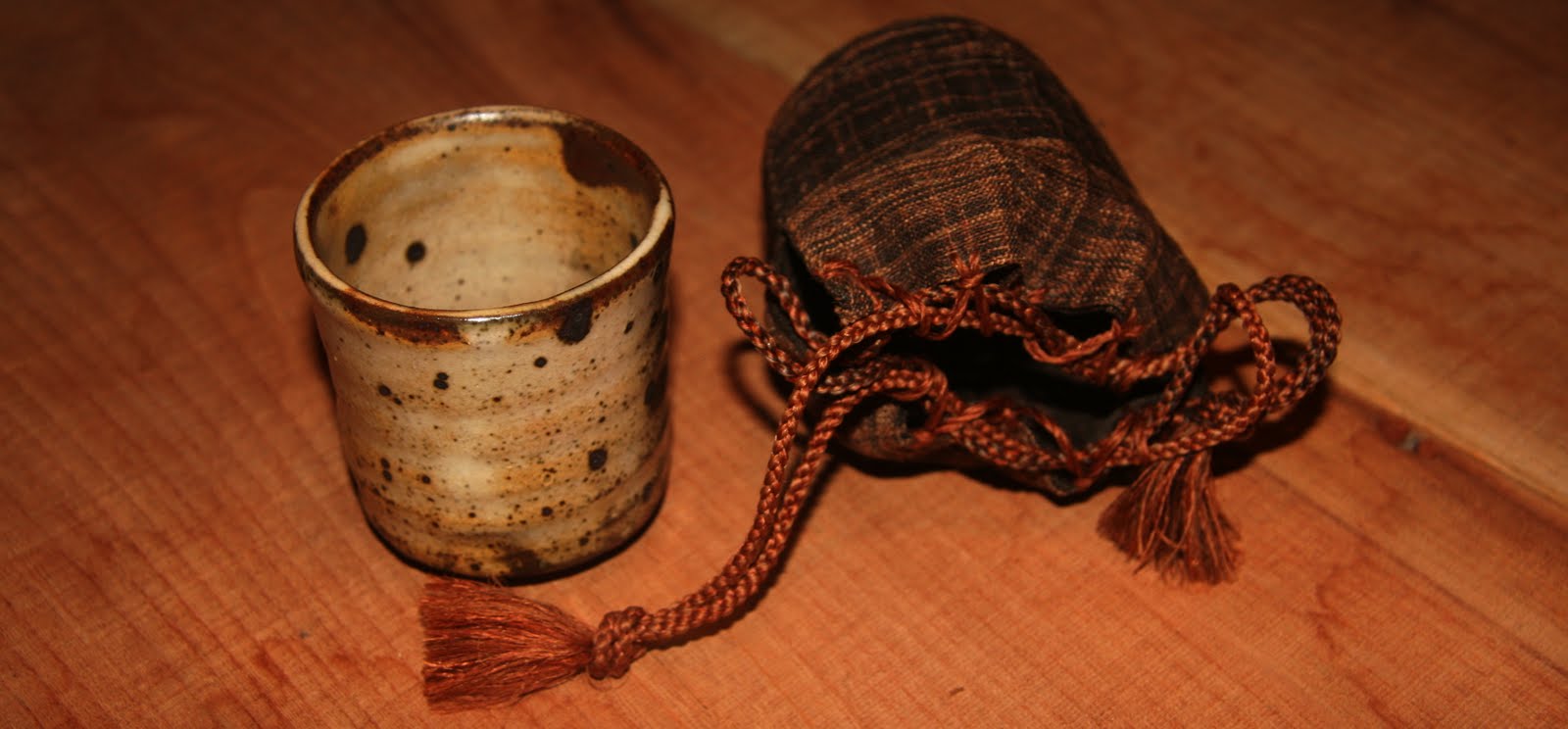
There was an exhibition of his work, that had sat cooling in the kiln as he slipped away from us, at the gallery in Tokyo where he often exhibited. The doors were stormed and the shelves were bare in minutes. I managed to grab a few pieces. One is this small sake bin.

Bittersweet...recently his work has been 'discovered' by a famous Japanese artist/curator and Aoki's work is now in demand and the prices skyrocketing.

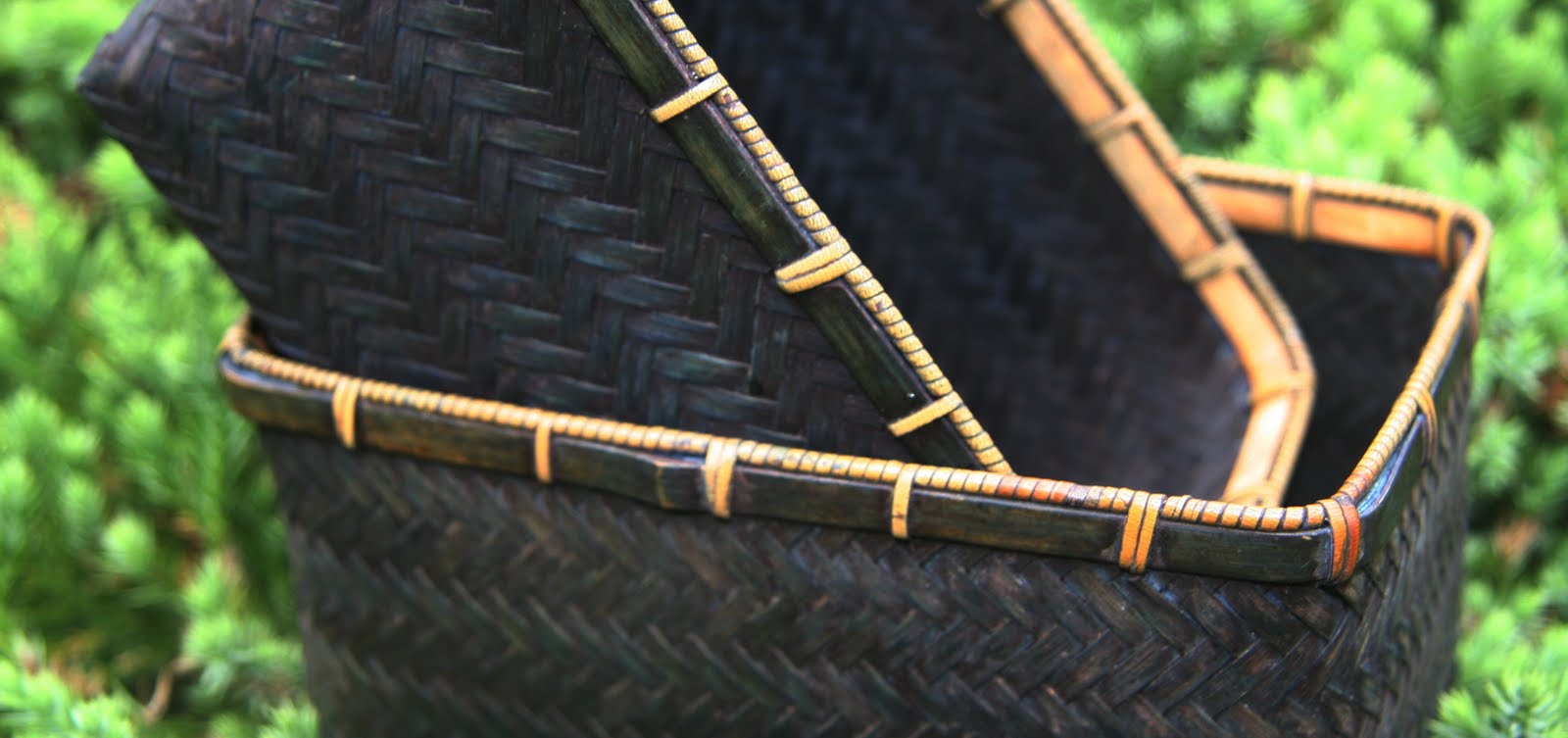
I wanted to honor him and the sake bin and I finally got around to weaving this small piece of linen and put together this bag for it. The indigo dyed bamboo basket was made another local friend, Ishikawa san, who gets his bamboo from our area. I taught him to process indigo to dye bamboo. My house is awash in bamboo baskets as well.

I made this silk bag from my cocoons many years ago for a sake cup Aoki san made. (Photo below.)