Justin wanted to solve one of the mysteries of life while in Japan. How to get the silk off the cocoon into floss and reeled thread. Here he is in the kitchen reeling happily away.
Friday, 12 October 2012
Kasuri First Try and Silk Mystery Solved
Imai san gave warp kasuri a try. (And me as well. Hardly qualified to teach kasuri I was winging it too.) There were a few problems but it turned out fine. She tried a few weft kasuri additions. Not perfect by far. But now she has an idea of what is involved in weaving warp and weft kasuri. Hmmm. Kasuri is a tough nut to crack. It is very difficult to get it just right. Design wise and technically. Having woven a few pieces, the artistic and skill levels involved in determining the value of kasuri become clear.
Thursday, 11 October 2012
Ogata san..
is motoring along. She stitched up and dyed the homework example for the autumn workshop. It turned out great and now her three daughters each want one of their own. Do they know how much work goes into one of these?
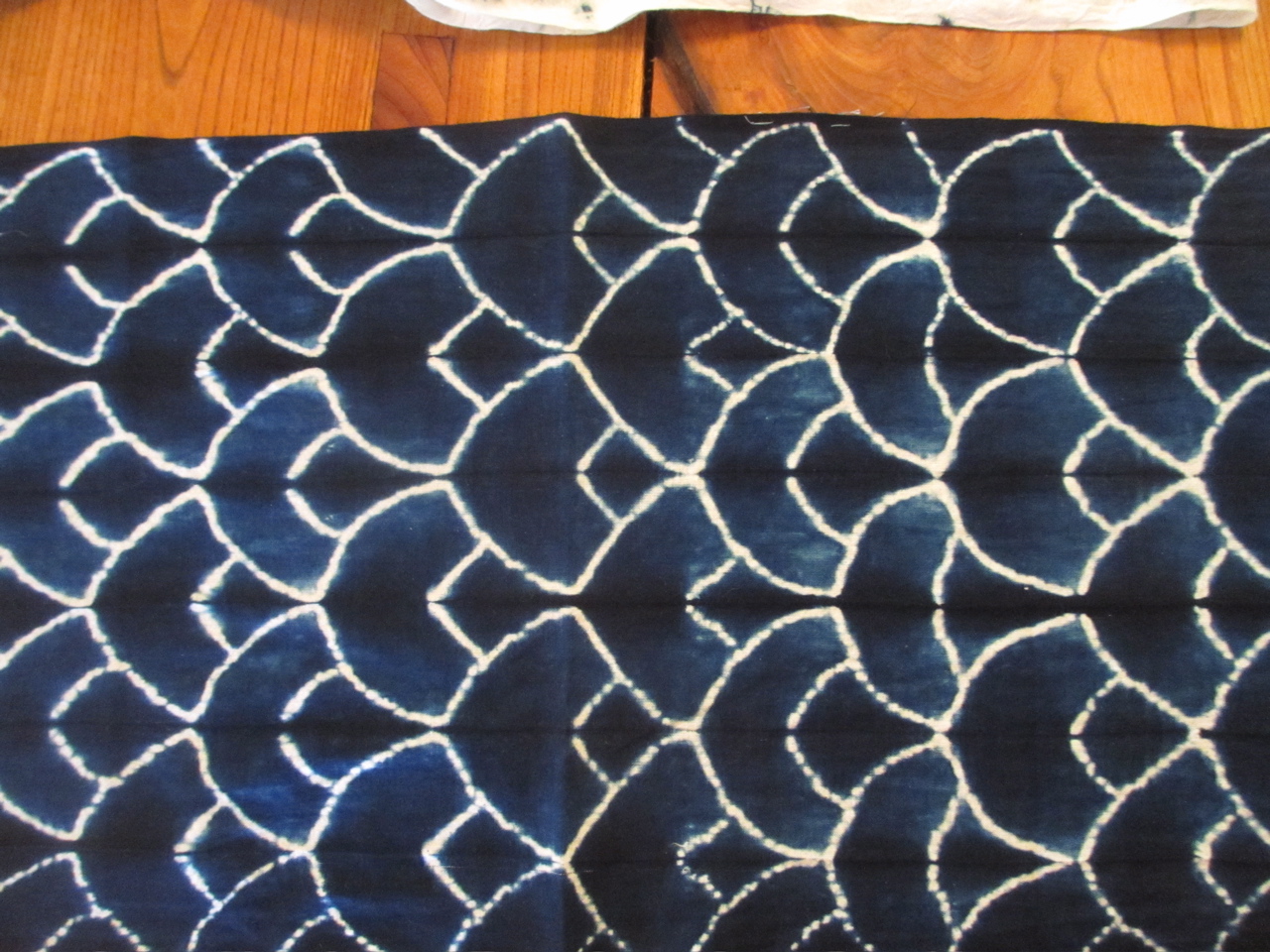
When the stitching is finished the threads are drawn up but not tied. Just before dying, the cloth is wet and then the threads are pulled tight and tied two at a time. Wetting the cloth allows it to compress more and the resulting resist stitching is clearer when dyed. You can play around with the tightness of each thread to effect the crispness of the pattern, You can see some of the stitches in the center of the shawl were not pulled as tight. This adds an extra dynamic to the finished piece.
Ogata san has a little crush on Justin, my friend visiting from the States. She loves his rings and tattoos and gentle bearness. (Come on spellcheck that has to be a real word.)
She arrived at the house for class and proceeded to check out the cherry logs I have set by the stream to grow mushrooms on to see if they had come out yet. No luck there but she noticed my flowering ginger myoga were blooming. She gave me a little slap on the arm and told me I was wasting them. She gathered some up and in a jiffy she had a side dish ready for lunch. Justin smiled and told her 'she rocks'. (She giggled as if she understood.) Love..the universal language.
Wednesday, 10 October 2012
Indigo Knit Cafe
For the past six months I've worked every Wednesday on remodelling a 100 year old shop that sits in the entrance to an old house. It was a mess. Packed with junk, (but a few hidden treasures) we kept the garbage men in shape hauling stuff away. Kurihara san and I just worked away week after week by ourselves clearing out a ton of old stuff, designing and rebuilding.
It is almost finished and we will open Aikoan 藍古庵 (Indigo Old Hermit Hut) in late November. It has some old knitting machines that make socks and tube knits for t-shirts. It has a small indigo vat outside. It has a shop selling my indigo work, both knitwear and katzome goods and work from my students. It has sewing machines and an over locker serger for friends to design, make and sell their knitwear designs. It has a kitchen to make food for guests and students. It has some great tables and chairs to use as workshop space. I am looking forward to having and managing a creative organic space. Here Daphne and I are checking out the funky plush loop sock knitter.
Here Liza and Justin are helping Kurihara san with shelf sanding and oiling.
What she looks like from the street. It needs a bit more love but what an improvement from six months ago.
Sunday, 7 October 2012
Stencil Cutting Homework
I sent out a few small sheets of persimmon tannin paper (kakishibugami) to the members of the autumn workshop for homework. This allows them a little time to think about what pattern they would like to make.
My friend takes old saw blades and makes these razor like cutters that work well with this kind of paper.
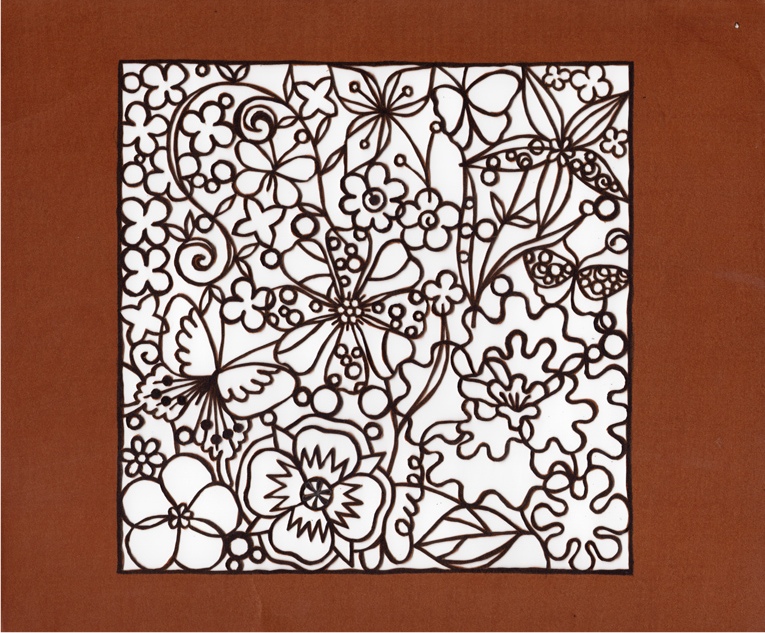
Catherine was inspired by Japanese family crests for most of these stencils she cut. Remember what you cut out is what you get. The holes you cut will let the resist paste through to the cloth. These spaces will be resisted and the indigo cannot reach the cloth. The red pigment was added to the paste just so that you can see where the paste has been spread. It washes out completely.
Touko chan cut out this more complicated stencil a few days back. Beautiful!
There are many images for katazome on Google images. My advice is to keep it relatively simple.
Friday, 5 October 2012
My blog has holes and is being neglected. I was really on a roll not that long ago. It's not that there isn't much going on. Quite the opposite.
The garden and area around the house is under construction. New rain gutter system around the house. Three stories high and several overlapping layers of eves makes things tricky. When we have typhoons the volume of water is unimaginable and getting it away from the house and flowing into the stream and down the mountain is a challenge. I figured out yesterday a clever way of extending the pond to take up the extra water from behind the house and at the same time creating an island in the pond to put in the new outdoor bath. Sounds pretty gorgeous and the muddy reality right now makes the plans seem almost comical.
Autumn workshop guests are arriving in a month. So many small projects on the go. Sanding floors, constructing windows and doors preparing warps for the looms for them to weave on. The balconies are all fresh clean new wood instead of the old 150 year old stuff that was always guesswork to step on. Tweaking and finalizing the workshop schedule so it runs smoothly but has room for some spontaneity. Again all my Japanese friends are so enthusiastic about who is coming and (almost too) eager to help out.
Classes are going well. I made the move and changed the big Finnish loom from a counterbalance loom to a countermarche loom and it is working. Some added beams and levers and it was transformed in just a few hours. (Leigh does a good job of explaining the differences in her blog, http://leighsfiberjournal.blogspot.jp/2007/06/comparing-looms-jack-countermarche.html ) We are all taking turns and weaving waffle towels. The tie ups are not as difficult as I thought they would and the students and I are excited about all the possibilities for future projects together. The loom and the room it sits in are alive!
The students progress and grow like well fed country kids. Every piece of shibori is analyzed so it can be better the next time. There is a katazome explosion of creativity going on. The house is alive and it feels like a early autumn renaissance is on us.
From Almost No Dog To Three
Snoopy had a stroke and was on her side for weeks. She was simply a goner. But as she has done more than a few times, she rallied and unbelievably she is up and around again.
Another Fukushima nuclear refugee is at the house. This time Momo, Peach is the new addition to the family. We know her owner who was forced to evacuate his home with his family to a refugee housing camp. It may take a few years but Momo will eventually be reunited with her original family. She is a real comedian. It will break my heart to let her go. Suddenly I have three dogs to feed and walk and keep happy and healthy. They spend their days outside and come in in the evening and sleep in the entrance of the house. Soooooo cute.
Snoopy, Geiger and Momo. For better or worse, through thick and thin...
Wednesday, 19 September 2012
Doubled Fold Wood Grain/Patterned Shibori Shawl Instructions
Here are some step by step instructions to make a gorgeous indigo shibori shawl. I have sent off boxes with the material and needles and thread etc. to the Autumn Workshop members for them to work on before they come stay with me in Japan. Shibori is so time consuming I want them to make at least one piece that they suffer (slightly) through to understand the value of a one-off-shibori piece.
The shawl is wide and in order to half the stitching time the material is folded in half and stitched through two layers. This technique is often used in Rajastani tie dye pieces. I've seen only a few pieces like this done in Japan traditionally. The Japanese would go through the extra stitching to get a specific pattern. I like the mirror image actually.
Here are a few pictures of Kawamotos san's shawl from a few months back.
Ogata san is working on a simplified version. There is not the secondary middle stripe to make a separate positive/ negative section. I leave it up to you to figure out how complex you would like to stitch.
First fold the shawl in half width wise. Iron that flat. Stitch the two open sides together so it becomes a tube.
The weave is almost gauze like. A double knot can easily be pulled through the weave so a ribbon is basted on the fold side of the cloth so that the knots will not be pulled through the gauze.
Horizontal stripes are drawn on using a blue disappearing ink (Aobana) at three centimeter intervals.
When all the horizontal stripes are drawn then the wave pattern is drawn in vertically. Avoid any horizontal stretches.
You can see the brown ribbon stitched onto the right side (actual center of the opened shawl) and the two sides stitched together on the left hand side.
First the drawn lines are stitched up. When you come to a line you jump over and continue stitching from the next line over. Double knot your ends on both sides of the cloth so they can't be pulled through.
I used a black thread to make it easier to see but white thread is fine. Sew two rows between each line so that you have a row every centimeter. Drawing lines every centimeter is no fun and stitching without lines gives an overall more interesting casual appearance.
And it should look like this on the back.
Subscribe to:
Posts (Atom)