Wednesday, 25 January 2012

Tokyo Quilt Festival


It is hard to digest all the work there. It is impressive to see how much thought and work go into making the quilts. An old line from a high school text book popped into my head. It was from Kennith Clarke in his "Civilization" TV series on the BBC. "It is hard to define what civilization is but not so difficult to see what it is not."

I prefer the quilts that would actually be used on a bed to keep warm. Most are made to hang on the wall. This is fine but still... A little wear and tear would make them look more beautiful. And hundreds of quilts hanging up under fluorescent lighting in a huge sports/rock concert arena. I would be nicer to see them in a venue more respecting the the millions of hours spent on the stitching and designing.

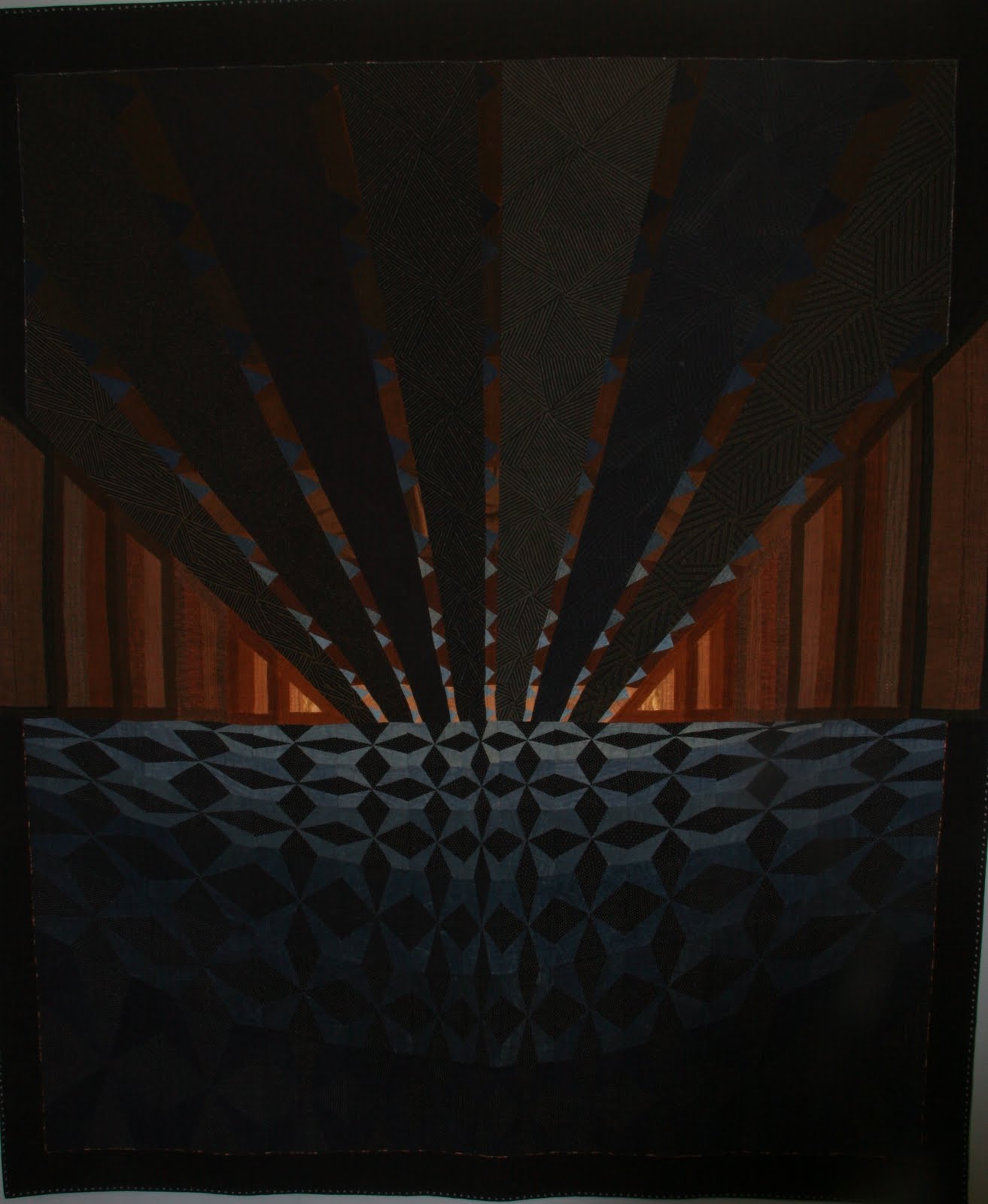
So many things impressed me. Here are some pictures.


Small scraps of silk Oshima tsumugi. It was good to see this precious silk used on something that will be kept for many years. Often these old kimono are taken apart and made into western clothing.


This was a clever usage of the old linen/cotton bags that were used to filter miso and make soy sauce.


Here the overall design is Japanese and the colors are very Japanese. The small shape motifs are so clever as well.


Of course their were plenty of blossom theme Japanese quilts.


This one was just crazy creative and cool.


A lot of indigo in the quilts,


Thursday, 19 January 2012

The Crazy Ones...


I have been a Apple/Mac fan and Steve Jobs admirer my entire adult life. OK. He wasn't the perfect human but he stood where humanities met technology and did about as good as a job as it as I can imagine. I read and re-read his biography over the winter vacation. And checked out that old ad campaign for the Crazy Ones...


Here's to the crazy ones, the misfits, the rebels, the troublemakers, the round pegs in the square holes... the ones who see things differently -- they're not fond of rules... You can quote them, disagree with them, glorify or vilify them, but the only thing you can't do is ignore them because they change things... they push the human race forward, and while some may see them as the crazy ones, we see genius, because the ones who are crazy enough to think that they can change the world, are the ones who do.
Steve Jobs


http://www.youtube.com/watch?v=8rwsuXHA7RA

(the link might not work from Japan. Just search on youtube for 'Think Different.')

The ad featured short clips of Bob Dylan, Amelia Earhardt, Picasso, Muhammad Ali, Jim Henson (muppets) , Martha Graham, Maria Callas, Alfred Hitchcock, John and Yoko etc.

Near my house two dear friends live and work. Their studio is called, 'Saiseiryu'. Recycle Way. They are both Japanese. She was born in Japanese occupied China and grew up in Tokyo and Moscow during the cold war. She later worked for several top Japanese designers,(Issey Miyake) and later worked as a clothing designer in Hong Kong and then many years in New York with their own brand (Pluto Cat on the Earth) with her husband. They never thought about selling as a priority. The fun and integrity are priorities. They don't think about integrity but instinctively work with materials that reflect their ever evolving relationship with this over-crowded and over consuming human species that is amusing itself and the planet to death. They make all their own clothing. Like John and Yoko they sit and talk about ideas and then actualize their ideas. (In their clothing.) After September 11th in New York they moved back and live a quiet life in the mountains near me. My town is famous for artists and I often wonder where they are....there are a few talented and famous and successful writers and painters and potters near by and I have been lucky to know them all these years. But Saiseiryu are special. They are still growing and their work has substance because it is real time as well as connected to the world at large. We had circled and eyed each other from a distance for a few years before becoming friends. Now I tear up thinking of the privilage it is to be near them.


They use only cloth they have picked up and re make it into...I could write volumes. But this post is about the New Years precious present they gave me.

They are almost universally seen as crazy. To me they are about the only sane ones in the town. They showed up at my house to pick up some stuff dressed in The Jetsons meet Space Janitor self-designed white nuclear clean-up uniforms with comical non-functional hard hats and Dalai Lama pictures and 'Toxic Waste Beware' printed on their plutonium clean up crew jumpsuits a week or so after the nuclear accident. "We were either ten years ahead or ten years late when we were wearing these in New York." I just kept a straight face as we had coffee and cookies but my other visiting friends thought they were actually heading up to Fukushima in these nutty outfits to clean up the reactor. I had a much needed laugh for days at their genius and guts.

Last year just sucked. Nuclear......grrrrrr.

It is an old tradition that the neighborhood guys put on a dragon/lion suit and come in through the front door and dance around your house uninvited to clean out the last year's bad energy and bring in new energy.

They showed up on New Years Eve with Jun dressed in a hand-made green robot bird and danced around my house with incense purifying the house and bringing in fresh energy for the coming year. Why a bird? "I don't want to be a human anymore....look at the stupid things they do. I'd rather be a bird and fly away from this mess."

Snoopy was feigning disinterest but she later winked and said that it is better to just play along with a straight face. I could have swore I heard her giggling insanely in her sleep that night.

Tuesday, 27 December 2011

Indigo Fermentation Started

Posted on my tour blog...sorry for repeats.


I got two decent harvests of indigo leaves from the same plants this past summer. Stripping the leaves off the stems gives you cleaner indigo balls. It is debatable if the is really worth it. (Some good sake and some friends talking as you work is enough to tip the balance.) The leaves were dried in the sun and kept up under the rafters to keep them as crispy as possible. It is really cold now and time to start them fermenting three or four months to make the bacteria laden sukumo/indigo balls. First we gathered some oak leaves and laid a good solid 50 cm bed on the dirt floor inside the recently cleaned out kura. The indigo leaves were wet and then half wrung out and placed in a straw bag. The wet indigo leaves bag gets put on the oak leaves and covered with another 50 centimeters of oak leaves and then a heavier straw mat placed on top and heavy stones to weigh it down and keep out oxygen. You want a slow ferment not a quick rot!

I am hoping that the fermentation goes slow so I can open it up when the tour is here in April. If it gets too warm it goes a little ripe. Fingers crossed!

Wishing everyone who reads my blogs a peaceful and meaningful winter holiday season.

Bryan

Monday, 26 December 2011

Loom to Go.


There are just too many looms in the house. I've collected a dozen or so old Kanagawa Takabata over the years. They were an easy find not so many years ago. Easy to spot in barn lofts and attics. Always missing parts and always slightly different from the others so spare parts had to be made from scratch. This one had to be over a hundred years old and like a three leg dog it got a little more love than some others that ended up as firewood.

Suzuki san is the infamous miser in the village. He had heard that I had bought a loom in the neighboring village and asked if I needed another. His grandmother had woven on it. It was black from the fireplace smoke. It was just pathetically rotten and eaten. As well as missing just about everything. When I loaded it on the truck and then went in for tea I asked him how much he wanted. I expected a "just take it" and I would hand him 10 000 yen and there would be show down to make him accept that. I laughed out load when he said he wanted 30 000 for it. I counted out three bills and told him what a great deal he was giving me. ( So he could grind his teeth all night that he didn't charge me more.) When he was young he was the only guy in the village who could read well. He worked on the board of education and he found out that the government was subsidising the mountain villagers to grow cypress that was needed for the rebuilding after world war two. He then leased all the land off as many willing villagers he could convince for a pittance and collected the subsidy money for himself. What a crook.
I love to hear the old stories from the villagers. Twenty one houses for hundreds of years...the same families and a whole spectrum of characters.


Anyway, I used the loom on and off and figured it was time to retire it to the wood stove. Takeshima san came to the rescue and it is now living in Adachi ku in downtown Tokyo! It practically fell apart as we attempted to dismantle it and lower it out the second floor window. Takeshima san will put it to good use.

Sunday, 11 December 2011

Scandinavian Looms Alive.


The two big Scandinavian Looms are alive these days. Kamei san finished up weaving four panels for a bed throw. She wove steadfast and sooo cleanly. I am proud of her. She had to weave to the last last centimeter possible to make the length for the fourth panel. Good work! I will post a picture of the work when it is stitched together and finished up.


Takeshima san is on the other end of a big project. Threading the reed. She is about to weave a poncho like blanket. Some dyes are natural and some chemical. It is her first time weaving a tweed. She is playing around with weft threads to get it just right before she starts the long haul 8 meter weave.

Dying with Cedar Bark and Alder cones on Silk


Left: Alder iron mordant overdyed with a single indigo dip. Middle: Alder cones with Copper mordant. Right: Cedar bark with copper mordant.


The mountain's decidious trees are vibrant copper and the veins of muted lumberjack green colored cedar trees that climb the gullies and hide the family graveyards were the inspiration for Tuesday's dyed silk.


The students who come regularly on Tuesday travel up to several hours to come to the house to study. I try to fit in some extra activity each week to make the trip worth it. It might be picking mushrooms or citrus or watercress from near the house for lunch. Often it is a walk to get dying materials. Something seasonal. This time we stripped off some cedar bark and used that as a dye. While boiling the bark we added some strong acidic agent to get a low pH. You can use vinegar but need about 50 times the amount. Once the dye bath was ready we raised the pH back to almost 6 with slaked lime.


Yashbushi / Alder cones The trees grow up the mountain in front of the house. (A hard climb.) I found a jackpot forest of alder trees on the slopes of Mt Fuji. My friend Mark and I gathered a good size bucket of these cones there once.(A good one hour drive.)


On the walk to get the cedar bark Kawamoto san saw some vines for making baskets just out of reach over a 15 meter drop off. So I ended up with three students suspending me off the edge by the top of my jeans. It was Ok. I was just wearing regular grey long johns.
Guillaume (back row) is the French Woofer helping me with farm and carpentry work recently.

Monday, 5 December 2011

Cleaning out the Kura

There is an old clay walled storehouse just outside my front door packed full of generations of semi-precious and semi-discarded belongings. Parking in front of it for 19 years and nothing changes except that more and more chunks of clay fall off and the twisted rice straw ropes and bamboo slats woven ingeniously into the heavy walnut pillars peak through..... like my own receding hairline. The covering is going to be shot sooner than later. Grin and bear it and think of eventual future options. A hat or some boards framed up the sides.


Last September the effort started by grappling and hauling out ten large wooden grain holders. Stepping on a rotten floorboard that whacked the resident Aodasho in head at the back musty dark corner I was lucky enough to have it wrap around my leg and bite me. Sheeeeesh.

The grain boxes have been sanded, oiled and outfitted and are being put to good use throughout the house as book cases, cupboards, tool cabinets.


The door has been left open since then hoping the snake would leave on it's own. He wasn't there when a small army of buddies helped rip out the floorboards two weekends ago . There was a collection of bottles of home made moonshine coveted away by someone. I heard from a neighbor that the great grandfather had fallen near the Snoopy-fall-in-river, broken a leg and then died from the injury just after the war. His secret stash lying there to be unearthed almost 70 years later. It was impossible not to ponder the changes that have taken place in the village and in the last century. Digging through the contents of the storehouse satisfied my inner archeologist. Old crumbling festival decorations to a kitchy 80's ceramic vase shaped like the Waikiki Hilton. Keeping an eye and an ear on the others to get a glimpse of what they were thinking and feeling I didn't register much. To them it seemed to be just a dirty old barn with the potential of being turned into a funky studio. They were probably keeping an eye and ear on me to see what I was planning to do with the space. (I am toying with a deadly cool bedroom/library/drawing room years down the road.)

There was plenty to think about as we hauled a mountain of everything out into the sunlight. Much of it hadn't seen the sunlight in a hundred years or so. And much of it smelled like it.
There were plenty of old saws and wooden buckets, barrels and tools whose functions are almost forgotten. A small horse saddle. (Visions of a poor miserable horsey in the cold up here where there was barely enough food for the people and plenty of back breaking work for him.) There were some poor looking loom parts and silk farming tools which I callously threw in the keep-warm fire without even closely examining them.

There were several broken down dressers with moth eaten piles of clothes. The older drawers contained kimono. A few hand woven men's silk kimono. Some badly deterioraed school uniforms from the 30s and the war period. The transition took place to western clothing in a single dresser. A heavy wool formal suit jacket and trousers. Neatly folded.

The clothing was spared the fire but thrown in the washing machine. Anything that survived the spin cycle would be considered keeping. A few items made it through.


One is this pilgrimage silk/linen jacket from before the war. It has been inked with a wood block of people climbing the mountain to reach some Buddhist figures and stamped with red ink. Beautifully galligraphed with the wearer's name, date, purpose and route of the pilgrimage. (The great-grandpa who had tripped and passed away three days later in 1946.) He had gone on a pilgrimage to a holy mountain and visited a Shinto shrine and Buddhist temple at the peak.

The owners of most of the stuff are long gone. They are in the family graveyard in the bamboo grove just above the house. It feels invasive to be rummaging through their belongings. It had to be done and decisiveness seemed to be the best defense against being creeped out. In the fire. In the garbage. In the washing machine. Re-boxed and put back.