Wednesday, 25 April 2012

Rocket Lamp and Shibori Prep.

OK. I took a few detours on the house renovations. There was an old milk can hiding in the rafters. Rusted and cobwebbed. There had been a small barn next to the stream in the early 70's. There had been a fad to keep milk cows. Poor things. It turns your stomach to think of the miserable cold impoverished conditions these animals were kept in. The dirty old milk container the only artifact left. Hardly a testimony to the hell these poor cows went through tied up in a pen in a small shack where the sun only hit a few months of the year. (At best only three hours day on top of that.)
I wire brush burnished off the rust and cut the milk can in half. Then heating it up and melting on beeswax to prevent it from rusting again. I sketched out some udders and asked my local glass blower to give it a try.  Her first examples were a wicked veined Los Vegas pink. Too realistic.

Do you know what a tequila sunrise is?
Yes.
Try for something like that.

I rigged up the glass udders and said a quick prayer for the old cow that had suffered from a fad and human idiocy. Made me feel better.

Shibori by udder light.
Early this morning the highway to Takao was empty and the valley was a cool silver blue as we drove. We said our goodbyes and it was suddenly silent as I drove back to Fujino to an empty house (except Snoopy) and more silence. The Textile tour preparations had taken up a solid eight month stretch of life.

Ten days flew by. We packed in a surprising amount of activities, some planned and some spontaneous. I'll write about them over the next month.

On the first day we arrived at the house and unpacked. Saito san and Junko prepared a sushi party for us.

After we hit the indigo vats.  I had a new stainless steel vat installed and we filled it with water, christened it with some sake and then added the indigo and then dyed some cotton thread. Kurihara san came the next day to pick up the thread and brought it back to us yesterday in a gorgeous knit.

Blandina holding out freshly dyed cotton thread.
The finished indigo knit fabric.
The view from the top of the village with mountain cherry blossoms out. 


Jean holding some freshly pulled natural madder/ akane.

Wednesday, 4 April 2012

Life Sign


The plum blossoms are out. They are almost two months late as the winter has been exceptionally cold. Looks as if the plums and the cherry blossoms will be back to back. We have had hurricane-force winds the past few days which seem never to abate.
Life is very good and very busy. Preparing for the tour members coming is eating into my blog time. I have a list of blogs and a stack of photos waiting to be put out but they will have to wait a little longer. I decided at the last minute that a second bathroom would be a good idea. The timing to put it in was a little awkward...wind storms and no walls at the north end of the house. Living in a wind tunnel for the time being.
The house has come along and I am humbled and so grateful to Yamaguchi sans, Kamei san, En san, Yoshi, Umemoto san and Marna and Shuji and many others for endlessly helping out and being cheerful. You are all making my heart ache with your kindness and generosity. The house might end up as a palace and then we can really enjoy it together.
I was honored to have the Ghibli folks over again the other day. Takahata san says he will bring the crew over to stay when the house is finished and the tour is over.

Monday, 5 March 2012

Shinto Purification


It is the home stretch now for the tour preparation. (Almost there.... just some glass in the window frames. ) Nat appeared out of nowhere and caught up in her whirlwind of enthusiasm we both jumped in head first to the Japanese Textile Tour World.... It is now hard to remember life without it.

At first we figured to have the tour members stay at a nearby log cabin resort. Imported log cabins from Canada...kind of like me. Considering the picking up and dropping off and the very non-Japaneseness of the cabins the decision was made to host the guests at the house.

There has been a constant flow of people coming to the house since I first moved in 18 years ago. Some slept in the hay in the old barn. Others have found their own little nooks and crannies to nest in. There was a good pile of futons on the second floor and the policy was to set up camp wherever you took a liking to. Fun for certain.... but not practical this time. It was time for an upgrade to the house. The house is big. In the "Impossible to Renovate Category."

It started with book cases and organizing all the silk equipment two years ago. Somehow the entire house was suddenly engulfed and under construction both inside and out. Then Nat showed up and the two year plan was condensed to 8 months.

Jeeesh.

First, my beloved outhouse toilet had to be seriously upgraded. Now I have flush toilets! Just amazing...Civilization has arrived.


I won't bore you all with house construction stories. Those of you have been there and done that know what it is like.

Last weekend Sugimoto san and his wife dropped by to wish me luck. (He was actually born in the house.)
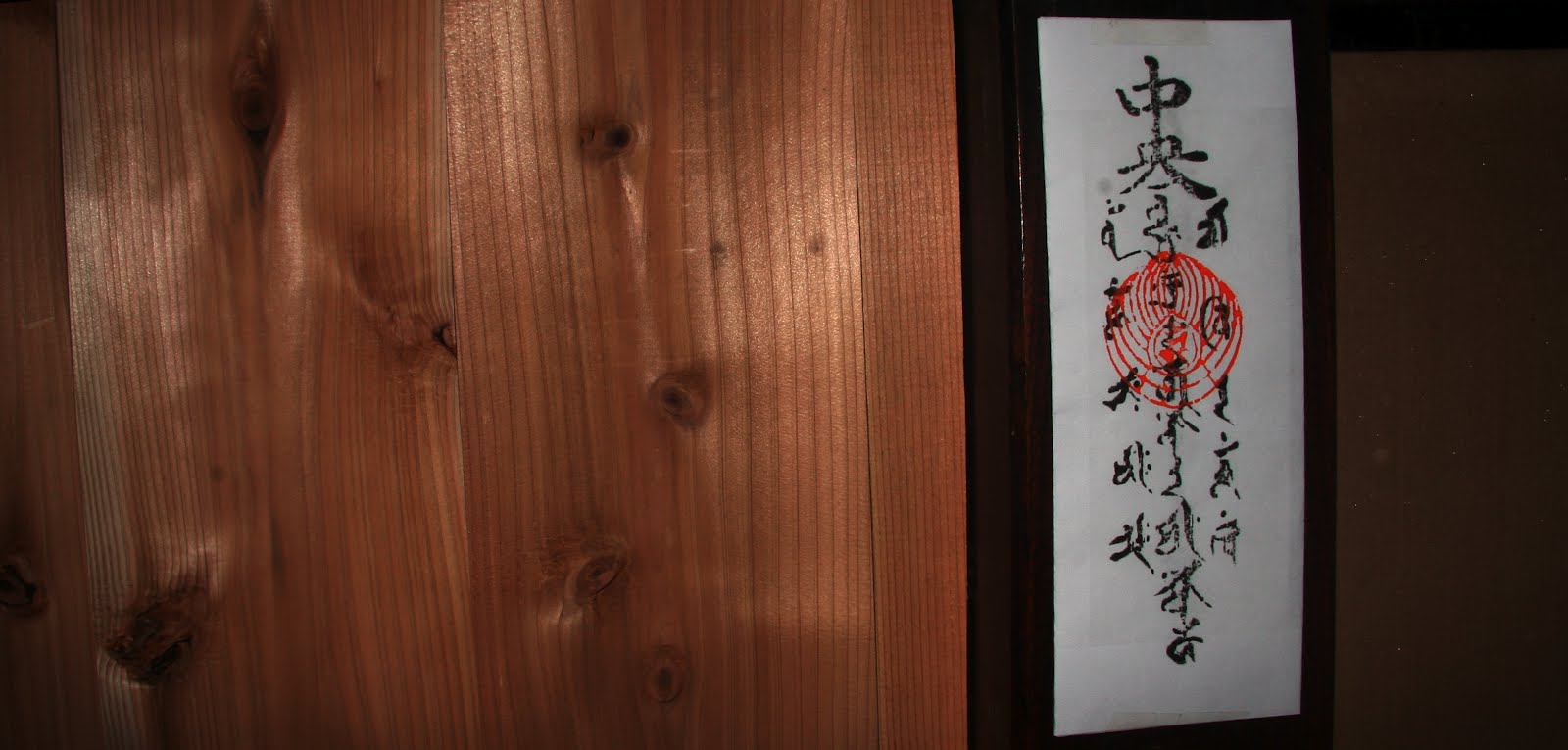
He wasn't feeling well and his son had been off work with the flu. I was complaining of back pains.... He figured that the root of all these health issues was that the house was put under major construction without offering anything to the house gods. The Shinto priest was to come on Saturday but for some reason he couldn't make it. Sugimoto came by in good spirits with his wife and would play the priest-role himself with a bottle of rice wine, a dish of salt, and a handful of Shrine-issued paper votives for appeasing the house gods for making a nuisance with house renovations.

The local dialect in this village is hard to follow. And try following the logic of these animist beliefs without offending the villager's good intentions.

Have you got an alter to put this stuff on?
Well ....no but will this old box do?
Sure.
Need a cup to put the rice wine in.
This sake cup do?
No. It is for the God you need something bigger.
How about this rice bowl?
Anything bigger? You have to dip the branch in it.
Branch? The house is a mess shouldn't we vacuum first?
(Blank look of disbelief...)
Did you bring a fish or something for the ceremony? Snoopy might take it if we leave it on the alter and turn our backs.
No fish this time. Do you have some sacred sakaki leaves?
No..but I can get some from the tree next to the graveyard I'll be back in five minutes.
Don't bother. Anything green will do.
How about a cedar branch.
What? (Disbelief) Anything else around?
How about that coffee tree branch?
It will have to do.


Sugimoto and I walk around the outside of the house clockwise. He sprinkles salt and chants while I dip the fake sacred branch in sake and sprinkle it behind him.
He chants.
"House God, good health to us all. House God please let there be no accidents until the construction is finished. Snoopy did a big job there you better clean it up. House God please make the house strong and last forever. The stones on the septic tank were a nice finishing touch. House god, I hope Bryan knows what he is doing and doesn't go bankrupt with house repairs. House God, How about an early spring?"

Some profound religious feeling missing here. I suspect the House God would be offended rather than pleased.

Back at the start of the circle it was time to tape up the votives. North, South, East and West facing walls. Above the entrance and on the central pillar of the house, then the big wood votive in the kitchen God shelf-shrine.

What is the tradition with the tape?
Hmmm... why ask such troublesome questions? No rolling the tape on the back. Make sure it doesn't fall down until next February or you will be in trouble.


What do I do with the leftover rice wine? Is OK to drink it? What about the leftover salt? Can I use it to cook with?
No answers to these questions. I realized that Japan didn't have hundreds of years of Christian debate setting down the do's and don'ts. No Thomas Aquinas etc. Just a kind of free for all. The rules instinctual.

Later that evening on the news the president of TEPCO ( Nuclear meltdowned plant operator.) says that the company isn't responsible for the radiation. They just make electricity and the by-products are not his problem.....


Tuesday, 14 February 2012

More on Sarasa Vegetable Pigment Making Techniques


Madder Plants


Boiled madder roots. Note that the outside skin of the root is pigment rich not the tough sinewy inner core.


Madder pigment settling to the bottom. Repeat this several times to neutralize the dye bath.


Filtering the sediment with a coffee filter.


The final madder dye pigment ready to be refrigerated.

Madder, akane '茜' is the root that produces alizarin http://en.wikipedia.org/wiki/Alizarin the only completely light fast and stable red dye. Every brilliant red color on cloth found anywhere in the world through out history up until 1860ish was made from this root. Think of deep red Turkish and Persian carpets, Indian print cloth, red colored tartans etc. The Japanese version grows wildly around Fujino.

Here is the wiki link for a quick read on madder. http://en.wikipedia.org/wiki/Rubia

Keeping it short...bring to a boil 100 grams of the roots in 2 liters of water, turn down the heat and simmer for twenty minutes. Remove the roots and filter the dye liquid through a medium mesh. Repeat the boil with another 2 liters of water. The roots can be used again and again to get paler shaded of pink on silk and wool. Making an extract you want the real dark stuff from the initial two boils.
Combine the two dye baths from the first and second boil. Add 10 grams of creme of tarter or the equivalent amount of aluminum mordant. The pH will be around 3. Use full spectrum pH paper to test. To neutralize the pH to 7 pour in ash alkaline until the mixture clouds up. (Creme of Tarter naturally clouds up when neutralized.) Pour the mixture into jars and let settle. Madder settles in about an hour. Remove the clear liquid and add more water to make sure the mixture is pure and neutralized. Repeat this three to four times.
Finally remove the clear water and pour the sediment into a coffee filter. You want the paste left in the filter. Scoop this out and put it in jar and keep refrigerated, It should keep for months if not years. This red pigment can be used as a stable paint with some binder on cloth or paper wood etc.

Madder has a long history and there are more than a few ways to extract the dye to get clear and deep colors. Another blog.

Sorry I was so cheap with lifted photos of sarasa on yesterday's blog. Here are a few from the kitchen today.


Left: Onion skins and cochineal. Middle: madder. Right (Yamaguchi san cut this stencil): combination. These are not finished yet. When it gets warmer they will get a background or accent color of indigo.

Monday, 13 February 2012

Monday Sarasa Research


Jars of settling cochineal purple dye.


Pomegranate skins ready to have the pigment extracted.


Cedar ash to make the alkaline solution.

There is a field/mountain of Japanese textiles that seemed just too difficult to run into. The bunny hill even seemed intimidating. There just isn't that much information out there either. So on Mondays these past few months Eri and I have been experimenting with making vegetable dye extracts and fixing them on cotton and linen. Our goal is to figure out how to make a vegetable pigment paste from the dyestuffs available in the area to use with a brush and use with Japanese stencil dying techniques. We will repeat the procedures enough that we are comfortable with them and can work with a dozen or so useful dyes. We have a stack of old books written in Japanese which individually nibble away at the different overlapping and confusing techniques. Going through stacks of actual antique materials we are very slowly figuring out which techniques were mixed and used with each type of cloth. Instinctively we are maneuvering through these to find what cloth we would like to make ourselves. We have pulled off a few lucky minor masterpieces already. Smells like beginner's luck.

The topic of sarasa itself is a tough nut to crack in Japan. The techniques came to life in some obscure corner of India in the 13th century. Fixing color on the surface of cotton with woodblock mordant stamping, metal stamp beeswax resist. cut out stencil dyes used with a paste resist and/or as a positive stencil, hand painted and endless combinations of techniques mixed with endless varieties of vegetable, animal and rock pigments. The cloth was imported to Japan in the 15th century on Portuguese ships. It spread and was both valued and despised for the foreign aesthetic brought with it. And the genius of Japanese adaption, refinement and technical improvement took off.

The authoritative reference books we got our paws on are often contradictory and not written by practicing artisans. Often edited/written by someone smelling a tad nationalistic and unable to place the techniques on a larger horizon and decipher them historically, aesthetically and technically. Great information is out there somewhere but for the time being it is better to swim around in the unknown and let a few bottom weeds tangle our ankles and cause some panic. Classrooms and detailed 'how to' books seem to deaden the actual work. The time will come to polish up what we learn but now is the time to run with the potential of each color and technique as we discover it. This is the dilemma of teaching. How to show just enough technique to create enthusiasm and have the students play and discover for themselves.

First the cloth has to be impregnated with a protein from soy beans. Then the cloth should be impregnated with a mordant. So far we have just used creme of tartar and aluminum. It won't be long before we will move onto woodblock and metal stamps meaning more experiments with iron and copper. Working with tannin heavy barks and nuts will also be necessary to get at the potentials of these techniques.

The extract method varies slightly for each dyestuff. Most require an alkaline solution made from wood ash. Take some wood ash and pour on boiling water and strain it. Let the sediment settle for two days and take off the clear water on the top. This ash alkaline solution is necessary as both a mordant (naturally occurring aluminium) and acts to help draw out the pigment and make it soluble.

So far we have made pastes from onion skins, cochineal, pomegranate skins, madder, suo, gardenia pods and cedar bark. You usually end up with a pigment mud the consistency of a rubbery toothpaste.

Basically you are making a paint that needs a binding agent to the cloth. Hide or bone marrow glue is the easiest and most direct method. The cloth ends up being stiff. Not the best for clothing. Strong mordant with a protein isn't as color fast but the cloth remains soft.

I will keep you updated as the experiments go forward and share insights and techniques.


A few images taken from the Internet.

Thursday, 26 January 2012

Lynette Anderson San


I was up early in the morning and the thermometer read minus seven. It had snowed a few more centimeters but this was easily shoveled away. Layers are the best way to go with clothing on a trip into Tokyo on a day like this. Leave the heavy leather coat in the jeep and make a mad dash for the train. The heat was on in the Tokyo Dome for the 'Tokyo International Great Quilt Festival'. (Couldn't they come up with a name that slid a little easier off the tongue?) I could swear I heard the old Sesame Street tune, "One of these things is not like the other , one of these things just doesn't belong...." on the PA system as I walked in. Thousands and thousands of quilter women and one rough looking snow shoveler bumbling in.

I was still bundled up toasty warm not quite sure why I was even there. I suppose I wanted to see quilts made with old Japanese textile scraps and there were some antique textile dealers from all over Japan. Great stuff. Always makes me smile. And to check out potential shops that the tour members would be interested in visiting. I brought along a few recent magazine articles about my work to make it easier to approach someone and strike up a conversation. For Japanese I can look a little scary with a beard fresh off the road cleaning crew.

My first stop was at Lynette Anderson's booth. She is beautiful and holding down her fort with her daughter and a Japanese translator. I was not quite in sync with the mood of the of the place, slightly sleepy from the snow and train ride and ten layers of clothes. I was fumbling around in my bag to find magazines and explain what I was doing at a quilt show. My face was red for some reason and then I realized it was partially because I was a walking sauna. Try peeling off a few layers of sweaters and keep a casual conversation going with someone you just met. Suddenly wet sweaty hair stuck to your forehead...
I couldn't find my camera to take a picture of the booth until Lynette reminded me that it was hanging around my neck and not in the bag. Her daughter giggled at my stupid face as I struggled to get it off my neck and take the picture. What a geek. Jeesh.
Look a the expression on their faces....entertained by the bumbling silk farming dork.


This is the same view yesterday morning as the 'Fresh Green' on the right side of the blog.

It snows and it gets shoveled, then it snows again....someone has hit the repeat button.

I have trouble getting links in this blog. I have a feeling it is Japan. Here is Lynette's quilting website. http://www.lynetteandersondesigns.com.au/