Monday, 29 August 2011

Small Bags for Precious Things


Aoki san


The traditional Japanese house has no real walls. Just sliding doors partitioning rooms. There was always an alcove called a 'tokonoma' where some piece of art was put on display. A hanging scroll of calligraphy or a ink painting, a piece of pottery and perhaps a simple flower arrangement. Unlike a western house where we will keep the same painting on the wall indefinitely, they change the display all the time. I like having a long term relationship and conversations with the paintings and things I have picked up through travels and life in almost every wall and corner and surface in my house. Two different approaches to displaying art.

Here in Japan, many of my friends keep their treasures out of sight and display them occasionally. The objects storage container is important. They love wood boxes here. Boxes inside boxes and objects wrapped in cloth.
I spent some years going to a class on Sundays learning to make the small silk bags for tea ceremony objects. There are some very talented potters in my town and I have been blessed to have some of them as my good friends. I could write a few books on the subjects of the potters in my town and pottery in Japan. My house is awash with pottery.

I was particularly blessed to have known Ryo Aoki for 15 years. He passed away at 50 years old, seven years ago. What a treasure he was. I met him when I first came to Japan and he had just started pottery. He felt he was ten years behind and literally killed himself through hard work making up for his late start as a potter. He had a vision and he worked towards it steadfastly. He lived in the middle of the mountains in a barely standing ancient farmhouse and studio. He had built a climbing wood firing kiln and was fulfilling his life work. He fell down beside the kiln as it was firing, not realizing his fever was from a virus and not the heat from the kiln.

I often visited him over the years and somehow I managed to purchase and receive as gifts a comprehensive collection of his work. A few pieces he gave me as a present because they, " are works of genius I can't possibly put them in a gallery and put a price on them." (He was a humble guy who couldn't help but be overwhelmed by his own genius and hard work at times.)

I am deeply indebted to him. There are very few like him. He inspired me and set a standard very difficult to achieve. His life was his art. And this is where the source of the really good stuff comes from.

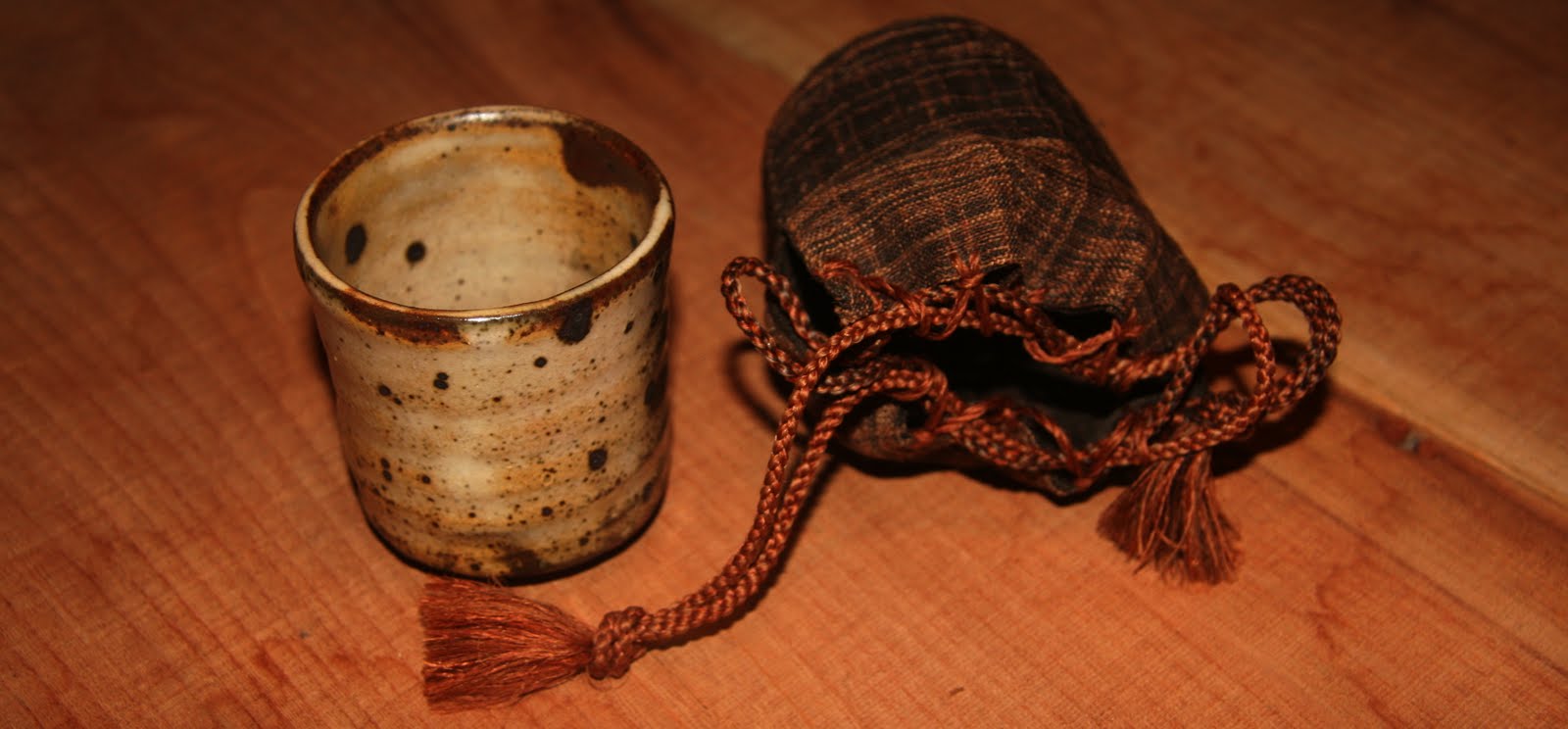
There was an exhibition of his work, that had sat cooling in the kiln as he slipped away from us, at the gallery in Tokyo where he often exhibited. The doors were stormed and the shelves were bare in minutes. I managed to grab a few pieces. One is this small sake bin.

Bittersweet...recently his work has been 'discovered' by a famous Japanese artist/curator and Aoki's work is now in demand and the prices skyrocketing.

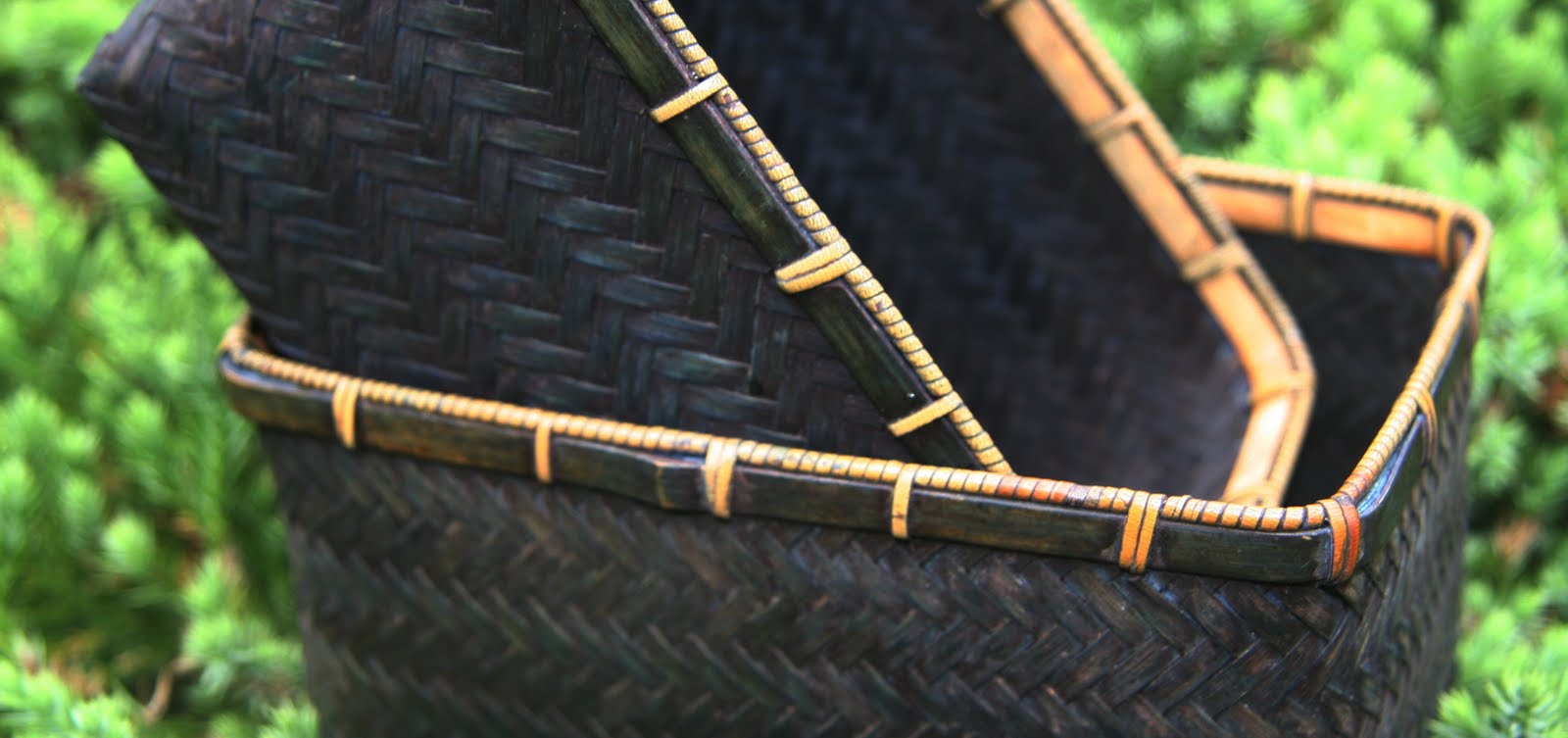
I wanted to honor him and the sake bin and I finally got around to weaving this small piece of linen and put together this bag for it. The indigo dyed bamboo basket was made another local friend, Ishikawa san, who gets his bamboo from our area. I taught him to process indigo to dye bamboo. My house is awash in bamboo baskets as well.

I made this silk bag from my cocoons many years ago for a sake cup Aoki san made. (Photo below.)


Tuesday, 23 August 2011

Old Lost Friend


Seo san and I worked together 15 years ago. She as the designer and seamstress and I as her indigo dying slave. We had a huge output for three years and don't regret a minute of it. Three years of producing shibori on a daily basis come rain, snow or sweltering heat put me through the boot camp of indigo dying/production. She used to bring out her grandchildren on weekends to play in the countryside while we worked. I hadn't seen Daiki in 14 years. He came out with her as a full- grown 18 year old yesterday and did some indigo dying today. It was great to meet him again. Like most 18 year olds he is wondering what he wants to do with his life. I suggested he become an indigo craftsman and live in Switzerland. He didn't dislike the idea at all. I found this old picture of him with Snoopy. Snoopy is aging the best I noticed!

White Shadow /Shirokage Fever Continues.


The students all want to get it right. The right balance and the right cloth and of course the right amount of white in the background. I am impressed with their tenacity and the results. This kind of shibori is really a tough nut to crack.

Sunday, 21 August 2011

Textiles for Tea Ceremony


These type of macrame (a Japanese word!) bags are used for three items in the tea ceremony. For a container that contains mini- sweets, for the container that contains the tea whisk and for the container tube-like container that contains the linen wipe cloth. This is my first attempt with some silk leftover from a previous project. Dyed with akane and walnut bark. I didn't expect it to work out at all the first try. Not bad though. I used a empty Saran Wrap tube instead of a round cork center. Next time will be easier and better.

Ko Kato


Ko san and digging akane (madder) in his mulberry field.


I wrote this blog just a few days before the tsunami and nuclear meltdown. There was enough bad news going around so it has sat in my blog edit pile for these past months.

I am very grateful to Minako and Ko Kato who live in a village on the other side of my town. 17 years ago I showed up at their front door and in poor Japanese I asked to see the silk kimono rolls she wove from the silk her family produces. Minako took me to their old clay storehouse and I watched as she opened some drawers and took out some hand woven rolls of naturally dyed hand spun and reeled silk. I took a good look at them and stood up straight and thanked her. In less than one minute the rest of my life had been decided. I was going to learn the processes and make my own silk and weave it. I needed to speak Japanese. I hit the textbooks and cassette tapes and in five months I was back on their doorstep asking them to teach me (in a more advanced state of broken Japanese) all about silk farming, thread making, old weaving looms and tools .

We became good friends over the years. I did need basic Japanese to communicate but our relationship built on years and years of non-verbal communication. Spending hundreds of hours threading and warping looms, digging dyestuffs and sharing time enjoying the lengthy processes brought us close together.

Sadly, Ko passed away last week at 93. The family called and I went over to their house and helped prepare for the funeral. In the country they still bring the body back to the house for a few days. He looked peaceful sleeping on his futon dressed in a white cotton kimono.

Yesterday the buddhist priest came and it was time to take him away to the crematorium. The family members and friends help dress him and prepare him for the seven day journey to the next world. He needs some cute white silk shoes. Some white silk leg protectors to keep the mud off his legs. A bag around is neck with six coins to pay for the ferryboat to the other side. A bag in case he receives any presents along the way. A walking stick because the path is hard. Some straw sandals to walk in. (The ties are cut though in case his ghost decides to come back thus making it impossible to really walk in them.) The coffin was filled with things he liked. Some sake. Some books.

Minako asked me to help her cover him with a beautiful indigo dyed kimono she had woven for him many years ago. She said to him, " Remember this one old guy? You raised the silk cocoons and I wove this for you. It is for you."

Then the coffin was filled with flowers and we drove to the crematorium. It takes about an hour to finish there. The temperature is kept quite low so that the ancient tradition of loved ones picking up the bones together with chopsticks can continue.

He taught me many things about mulberry cultivation and silk farming. I spent many afternoons listening to his stories of the war and the self sufficient ways of the old days. ( He would set a fish trap on the way to elementary school and bring the fish back home after school for the family to eat.) I suppose one bond between us was that the three of us knew very well that life in that simpler time was far more sophisticated and enjoyable. I miss him.

Thursday, 18 August 2011

Thoughts on Teaching Weaving. Part One


When I opened Japanese Textile Workshops at my house I had no real idea of where I would draw the boundaries on what I would teach or who I would teach to. I started with a few looms, a few indigo vats, a large collection of silk reeling tools and kumi himo stands and a lot of knowledge of Japanese textiles I had picked up over many years.

In the back of my mind I wanted to teach how to make high quality small pieces of textile using different techniques that could be used for the tea ceremony. My students get a chance to do everything. Help raise silkworms, reel cocoons, throw the raw silk and de-gum it, use vegetable dyes to color it and make bags and belts and eventually kimono. That would be more than enough but the worlds of stencil dying and shibori with indigo are too much to overlook.

The students who approach me to study all have different goals and different lack-of-goals I have to consider. Somehow it all works out as they grow as textile people and I grow as textile teacher.

I use back strap looms to introduce weaving to my students. At first I set an entire loom up and they simply weave two meters. The second time around they indigo dye the thread. Think of the pattern and set the loom up themselves. For any one out there considering teaching weaving this is something to consider. The students do not need to put out a large sum on looms and other tools when they are uncertain if weaving is what they really want to do. They can take the looms home and weave homework. I teach how to make the bamboo reeds and heddles. They make their own back strap pillow part of the loom from their first weavings. The shuttles are made by a neighbor from local wood.

Stencil Dye / Katazome New Direction


Eri has focused on indigo dying, stencil dying and shibori. I was lucky to have a whole class with her alone on Tuesday to talk and see where she would like to go with her time at the studio. She brought in a beautiful detailed stencil she had cut for homework. Small circular stained glass like motifs that seemed Taisho period influenced. (1920s Japan)
First we lacquered on a silk net to enforce the stencil. This is tricky work. It has taken me years of practice to get it right. The key operating words to success are 'slowly' and 'carefully' and 'very patiently'.

When we got the net fixed on the stencil Eri asked if it was possible to use the stencil with other colors besides indigo. I had secretly been dreading the day this inevitable question would come. It opens up an entire new time consuming world. As we usually use hemp or cotton with indigo to use vegetable dyes entails impregnating the cloth with soybean milk before dying. A protein is needed to bond the color pigment and the metallic salt to the cloth. I know that once the other students see the potential of this technique they will all want to do it. The lid is off now.
To make a rambling blog short, this is what we came up with. Lac dye mordanted with aluminum and steamed to fix. Re pasted with rice paste and double dipped in indigo. There are a lot of possibilities just with this color combination.