Thursday, 18 August 2016

Textile Adventures in Russia.

As we read and heard, social connections seemed to have been paramount in Russian and Soviet society. Not 'what-you-know' but 'who-you-know'.

Anna's friend has the title, "Keeper of the Russian Textile Collection" at the Hermitage Museum in St. Petersburg.    

As a textile tourist in Russia one couldn't do much better than that.

The line-up to buy tickets stretched for blocks. We walked past all those sweating Russian tourists and serfs up to a very noble high iron and wood door with a cool breeze off the Neva and waited while Anna called her friend to let us in the back door.


 In the meanwhile a black immaculate Audi W12 pulled up and a few immaculately dressed men slipped out of the back seats and slipped seamlessly though the immaculately timed open door. It closed with a faint whiff of oak.

Tatiana appeared as the door opened again for us moments later. (It creaked a little...perhaps we weren't  cologned and Brioni Vanquished well enough for the oak breeze treatment.)

Hidden corridors occasionally interrupted by gilded doors. We had to pass through the the palace rooms that were tres public.
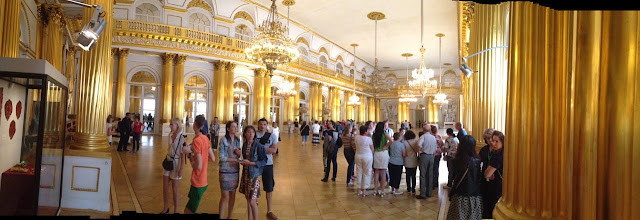


I started to get the idea of why the Bolshevik revolution started here in St Petersburg. What are the words..... terrifying .......opulence? 500 palaces side by side lining the canals and streets of St Petersburg. And this winter palace of the Tsar now the Hermintage Museum.....Brain Cracking.

We got the inside tour for a few hours. Visiting a Haute Couture exhibition being set up and not yet open to the public. The work of Vyacheslav Zaitsev, the Soviet Yves Saint Laurent. Hermitage link to the exhibition.

The impressive Issey Miyake exhibition recently seen and worshipped in Tokyo seemed a bit like a deflated balloon in a public park compared to this one. (Just kidding....The Issey Miyake exhibition was impossible to forget.)

Tatiana had worked on restoring and remaking the textiles in one of the Tzar's throne rooms. The one he used to commemorate Peter the Great, founder of St.Petersburg.

The massive room had been damaged during the war and the Soviet government was not priorotizing the refurbishing of the Tzar's throne room.


When removing the embroideried insignia from the walls and throne of the room for restoration Tatiana realized that the room was originally not royal cherry red but actually a deeper darker red.  The naturally dyed madder red had faded with time or with something in the cleaning water or actual air itself. 

The decorating had been well documented in the early 1800's. With the Nazi blockade and the Bolshevik Revolution and then the Soviet Era it is hard to imagine these documents survived.

They did.

 Tatiana was able to locate the French company that had produced the silk velvet and brocade for the wall panels, curtains, and the throne itself. They were still in business. They still had the sample books and the thread counts and brocade patterns in their old library. The materials were reproduced and the room re-reddened and ready for the millions of tourists who diminutively and awestruck slide through the palace rooms in plastic bagged protective shoes.


I need some more time in St Petersburg. Tatiana has invited me back in the off-season to spend more time in the back rooms. I received a formal invitation to a conference of textile restorers in December 2017. I can't wait.

Thank you Tatiana and Anna....I could never have imagined what an amazing day it was going to be.


Friday, 22 July 2016

Finnish Folk Craft Museum:

Henri and Ilkka were such generous hosts. We spent a few hours  visiting the Finnish Folk Craft Museum in Jyvaskyla. A small museum. Just the the right size.Downstairs is the permanent exhibition that focuses on Finnish textiles. It was my third day in Finland and the third loom set with a rag weave. This grandma's grandma of a loom had some charming features. Wheels built onto the the frame itself for the shafts.


The crank for the back roll locked interestingly on some carved wooden hooks on the side of the loom.


There was this patched and worn sweater hanging in the display. There had been a young couple who fell in love. She knit him a sweater before he went off to war. She married someone else in his absence. He never married and lived a sort of hermits existence. He died with very few possessions. He did have the precious sweater repaired by himself over and over during his life.


There were mannequins behind glass wearing tradition clothing. Some of the clothing original and some painful reproductions.  The clothes were red and blue and white. Madder and indigo were available in Finland in the closing years of the 19th century.


We all got very excited to find a display with actual madder roots and a brief history of how it was used. It grew well in the short Finnish summers and thrived in the soil there. Henri was excited as his grandparents have a lot of extra land on their farm to start cultivating it.

We had plenty of laughs naming the future madder- product-design-studio with plays on English and Japanese and Finnish words.  We had plenty more laughs choosing the ideal red Finnish building as we drove along through the scenic lakeside birch forests.

Back to the museum...

The temporary exhibition upstairs was informative and we each fell into our own thoughts as we walked through.

The exhibition was simple enough. It centered around a 'make-it-by-hand' craft magazine called, 'Omin Kasin' which printed it's first issue in 1938 and it's last issue in 1971. 

Those dates alone started the wheels turning. Russia , their big next door country had been their enemy and the Finns took sides with the Germans. Paying war reparations for helping with the blockade of St Petersburg put stress on the country's coffers in the post war years.


 This magazines contents could not but reflect this reality.


" With Our Hands exhibition brings back memories from the past centuries. It presents parts of the development of Finnish handcraft, the craft industry, and design between the 1940s and the 1970's. The name of the exhibition refers to a magazine, which lived side by side with the Finns in the post war period. With it's  handcraft instructions and tips the magazine marked a way to a happy and practical everyday life in an era with major social transitions.

The models, instructions and patterns in the magazine were designed to be useful for everyone. They were suited to a traditional farm household as well as to a modern urban home. Besides crafts, hints were given to fashionable dressing and interior decoration. 


During World Was II clothes and supplies for the soldiers were made according to the instructions in the Omin kasin magazine.  After the war there was a  shortage of raw materials, but it was no reason to give up making handcraft. Instead new ways to fix, reuse and recycle the materials were invented. However, beauty was not forgotten: the companionship of practicality and beauty were highlighted in the magazine. "


I am interested to hear my readers thoughts and recollections on these kinds of magazines.


Some weaving from the late 19th century that indicated there was a source of rose madder  and indigo in Finland.


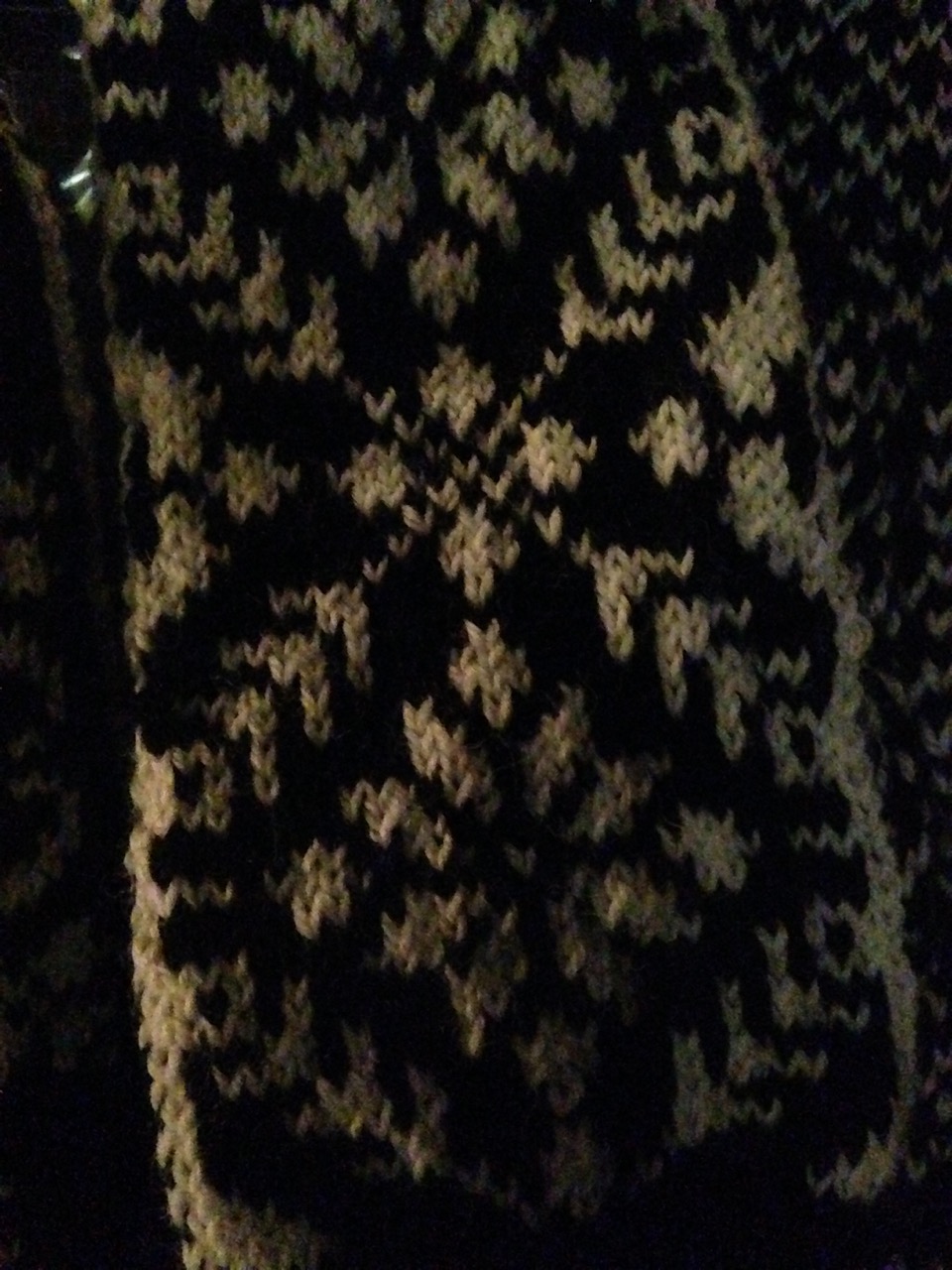
And some lovey hand knit mittens wth traditional patterns.


Here is picture of Henri's original weaving. There is a man out there with great taste and weaving skills!

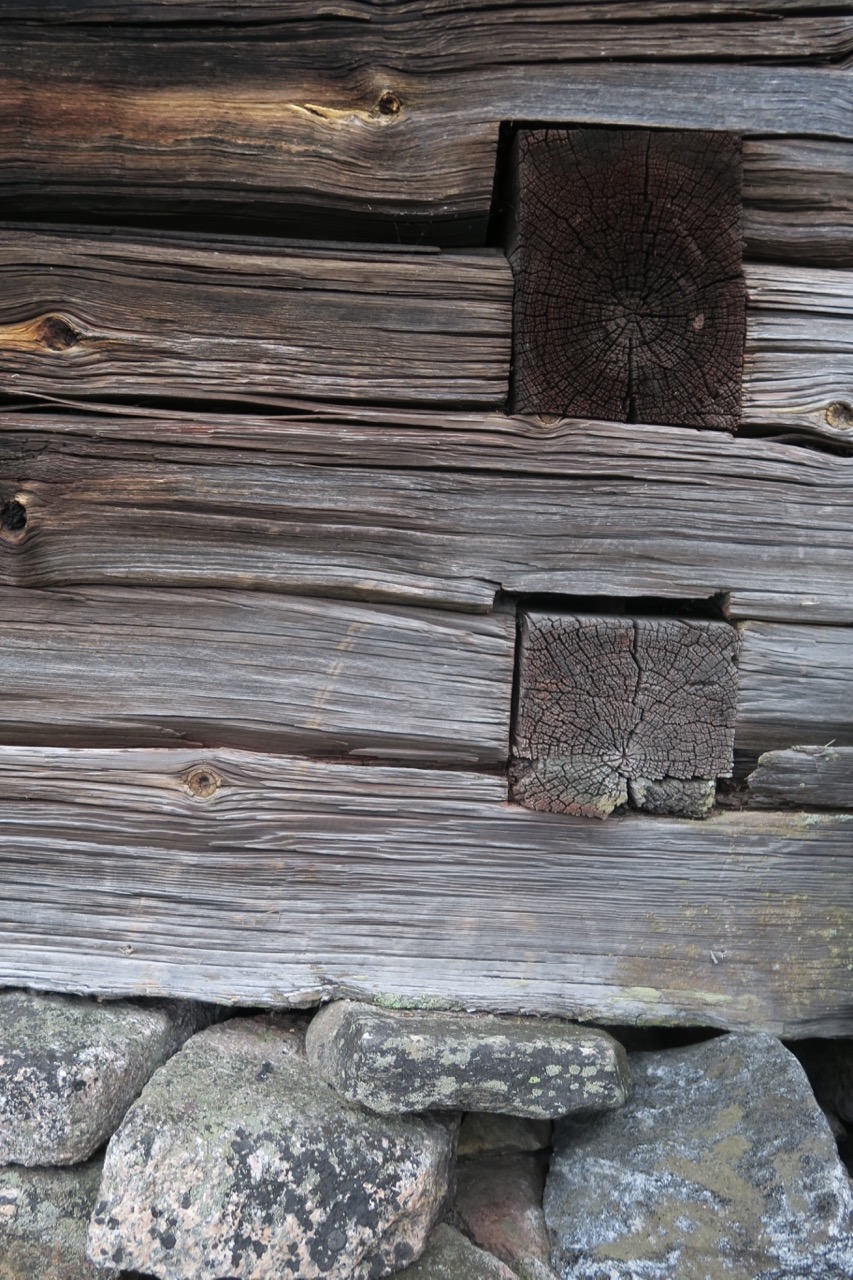
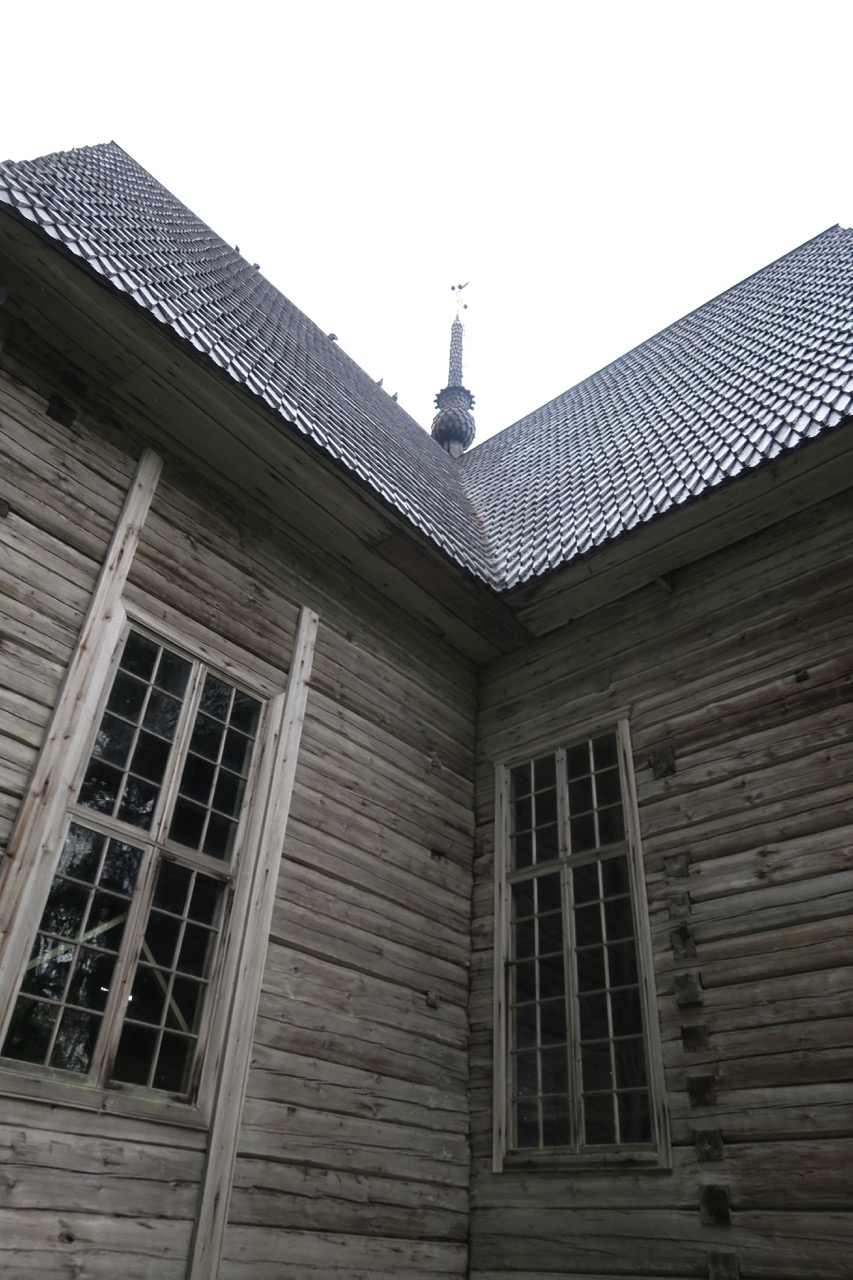
 Here are some pictures of a wonderful wooden Finnish Church. The texture of the wood and the solemnness of the structure were impressive.


Textile Travels in Finland


Picture for you Jean!

The warp and weft of those few days in Finland were woven together with the threads of my past students and their families and life experiences and pride in their country. The egalitarian nature of the country keeps the selvedges even. Like the Finns themselves, the traditional textiles mind their own business and smile gently.

Ilkka Saarikoski spent two months earlier this year at my place in Fujino working with indigo dyeing techniques and sewing Japanese jackets as an internship from his studies at the technical school here in Jyvaskyla. 

His prodigious work output is now on display at Jyvaskyla's premier coffee shop.
It was heart warming to see Ilkka's work he laboriously made in Japan appreciated in public here in Finland. The quality of the work certainly deserves recognition!


Henri Hyvarinen and Ilkka know each other from textile school. Henri spent two months at my place three years ago.  A weaver, a felter, a dog sled driver, a lumberjack and massage therapist, and a part time Viking...I love you Henri.


Ilkka and Henri and Rauno, Henri's ten-month-old-uber-enthusiastic-Finnish-bear-hunting-dog-cross-Dutch-Shepard and I spent a wonderful day together.

The four of us walked down the street to the coffee shop and Rauno met several white-fluffy-four-legged-dog-breath-mints along the way.

Rauno sniffed and wanted to play with the mints.

I braced myself for the bloody worse each time. 

Coffeed up and ready to go we drove though the Finnish countryside to Henri's maternal grandparents farm. 


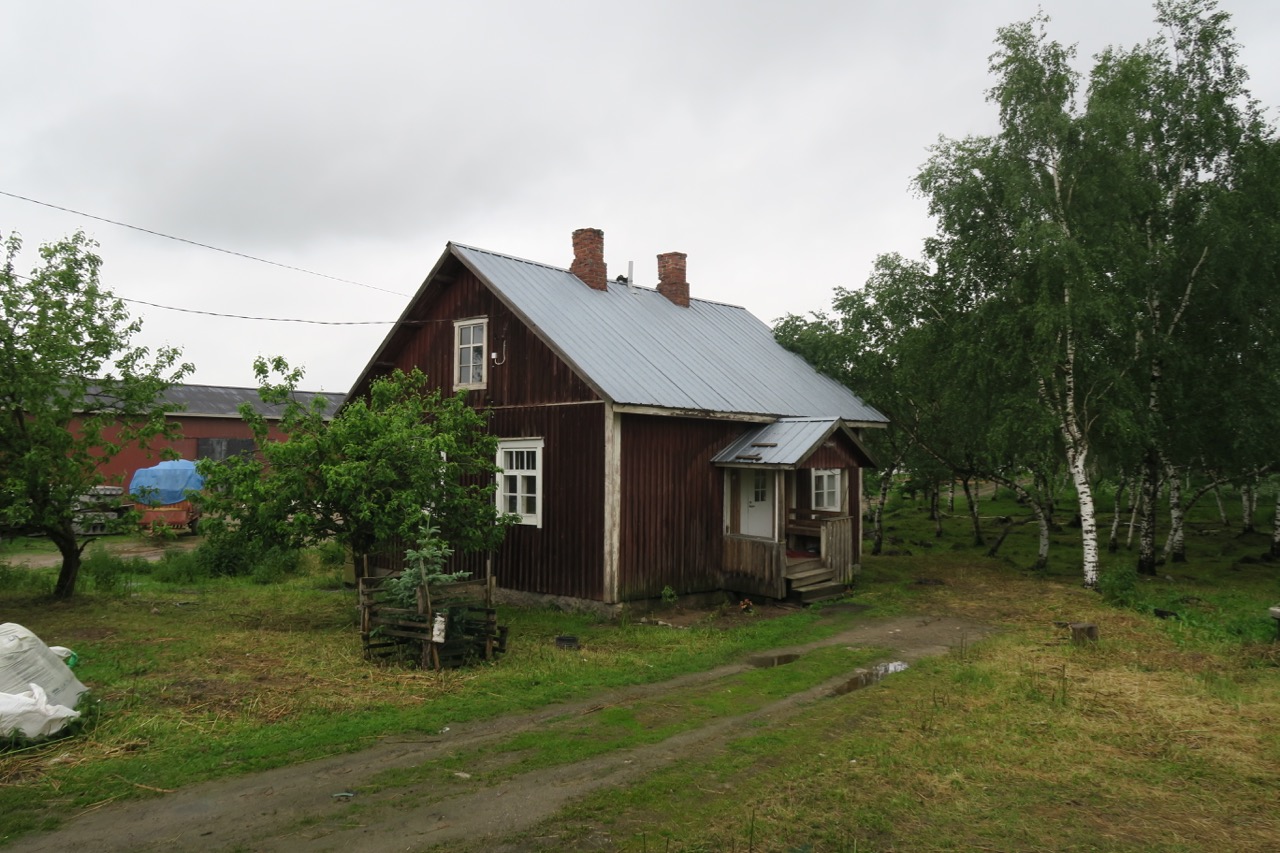
The Finnish countryside is peaceful and gentle. For thousands of kilometers it looks much the same. Rolling hills of pine and fir and birch trees and lakes with reeds flittering in a soft breeze. Many shades of subdued blue lupine and lilac line the roadside. The entire landscape evenly peppered with red iron oxide painted houses with white window trim.

The door of the farmhouse opened and the long forgotten smell of cooking rhubarb from 45 years ago triggered memories. We sat and had tea and homemade doughnuts (monks) and tried unsuccessfully to take the Finnish challenge of eating them without licking ones lips.

 The conversation turned to dogs. 'Rauno has a good disposition and his only quirk is to relocate clothing lying around.' Grandpa Lauri chuckled and recalled a dog he had as a boy.

"We were swimming down at the lake and while we were in the water the dog carried our clothes all back to the house and we had to walk back home red-faced and bare-assed the whole way."

Grandma Kaisa is a weaver and I was delighted to see she owns the same Finnish loom that I have back in Japan. She had it warped for rag weave carpets. I could see her prodigious output throughout the house....with Rauno skidding through the house and messing up the lay of the carpets. He is easily forgiven with those gentle playful eyes. 


Back on the road we drove to a sheep farm in Henri's hometown where he buys fleece to felt.
(www.piiku.fi) To the side of the majestic unassuming manor house, amongst the "curly birch variety" copse there was the obligatory old iron oxide red cottage.  Inside there was an unpretentious (the adjective pretentious doesn't seem to exist in Finland) wool shop selling yarn and roving and needle felted roving for felting. 

I could have spent months there but followed the rules for visiting a studio. Be quiet....words are heavy. Be enthusiastic. Be respectful. Shop fast and leave promptly and politely. 


I did make some purchases. I know farmers are always busy and made my way to the car.

Eeva, the woman of the farm asked if we would like to look at the sheep and her carding and dyeing studio. We sheepishly said yes and followed along like sheep to look at our brethren. 

We drove on towards Henri's house. His family and ancestors seem to own the whole town and we chided him about being part of the family mafia. Every field and shop and house and lake seemed to hold some special significance to Henri. 

My face ached in three directions. From smiling at his adorable enthusiasm for his hometown and country. From gritting my teeth in terror of his maniacal back road speedstering and from the pure pleasure of dog licks on my face and ears. 

I suspect face muscles are made to express one emotion at a time. Three at a time just invites wrinkles.

We made it to Henri's parents place....a Finnish lakeside humorous variety show of magical old buildings, barrel saunas, docks and boats and dozens of huskies snoozing in the forest dreaming of winter. They are waiting for the snow to pull sleds through the white landscape and over the frozen lakes.

I got to meet the legendary "Harmo" the half-wolf half-husky. His mother would make a bee-line for the forest when free and came back pregnant....with wolf puppies.  


A great feast of salmon chowder and home made moose sausages and assorted breads and rhubarb juice was on the table waiting for us. I shook my head in disbelief at their full-hearted generosity and good will.


There were some old Finnish tapestries on the wall from the 18th and 19th century. It was clear that the Finns had a form of indigo and madder root available.


This particular piece was stitch embellished on a hand woven hand-spun background. 

This second piece was hooked on a handwoven background.


I was travelling with my red security blanket and Henri's Mom checked out my selvedges to see if they were clean. (not)

A moose suddenly poked his head in an open window to check out the weave structure....

Henri's mother is a Finnish traditional clothing historian who has researched and woven traditional clothing and made reproductions for a museum.

The book she showed me about the different regional variations in traditional Finnish costumes was amazing.
Between bites of moose sausage and spoonfuls of salmon chowder and sips of "yellow wine" I tried to keep a polite conversation going while being engrossed in the book.

Wednesday, 20 July 2016

Textile Journey Starting in Finland.

I arrived yesterday to Sammatti , a small town of 3000 people in the countryside of Finland for a short visit to Hanna and her family. Hanna and I spent time together twenty years ago in Fujino when we were young and life was simple. I gave my first silk reeling demonstration to her. 

The gentle spring in the mountains of Japan is over. The humid rainy season has started. It was time to get out of there.

Leaving Japan felt like an action movie where the main character suddenly finds himself on a plane with a cocktail or skiing down the alps in solitude or falling in silence after his parachute opens after a storm of gunfire and car chases. A maelstrom of chaos and then some sudden state of welcome peace and equilibrium. 

A chuckle and a sigh and a deep exhalation simultaneously occur. 

Two thousand silkworms cocooned the night before I left. My guests from Otis College left and the house got a thorough and fast cleaning. One thousand objects picked up and put back in the places they belong.


 Four adorable destructive kittens had to be played with and enjoyed before their precious kitteness fades before I leave for a month. Several mad trips to central Tokyo to secure travel documents for Russia. A few minutes stolen during the last few days to enjoy the garden and  a few minutes of regret I will miss most of dozens of lilies planted last autumn and about to bloom. 

Packing with uncertainty. A suitcase next to a backpack. If the Russian visa came through it would be mostly an urban trip of museums and restaurants and long strolls through the old cities.

 If the visa didn't  come through I would buy a bicycle and camping gear in Helsinki and spend five weeks biking up to Lapland in northern Finland.

The visa came through at the last minute.

Packed the suitcase and packed the backpack away.

In the meantime, I get to visit a few dear friends. Hanna and Henri and Ilkka. Unfortunately, my old buddy Aleksi couldn't get away from London to visit his home country and meet up. I remember warm kitchen evenings while it was minus 5 outside in Fujino listening to him tell me about the Finnish soul. (Every Finns dream is to live in a red house with white window trim in the countryside with a garden and a sauna.)

The sun doesn't set this time of year here. 

We walked by an old leaning red barnhouse that has been turned into a folk museum of sorts late last evening. I peaked in a window and saw an old Finnish loom in the corner.


I convinced Hanna to bring me back at noon in hopes of getting inside to get a closer look. A shy young groundskeeper took an ancient key and opened the door for us. Creak creak...time and culture slip.


The faded walls and worn floor and weathered wood furniture with the the smoke stained plaster oven/stove created the illusion of a digital photo/reality filter . The rooms were here were sized for me. (Genetically, I have some height genes from the neighbouring country. )
Living in Japan in the old farmhouse with its low ceilings and the Japanese use of space doesn't ergonomically work. It is like living in  a 25% reduced diorama. Not without attractiveness but bad on the back.

The details of the loom construction were different yet familiar and charming. A different sturdy delicacy than Japanese looms. Someone had warped the loom with a rug rag-weave using the same vintage of ripped cloth that the digital room filter had been adjusted to. Icy smoked tundra earth tones with dusty dried rose accents.